

11 Aug Getting the Business Out of Your Head
Founder dependency is one of the quietest value killers in a sale. Here is how documenting your business lowers buyer risk and raises your multiple.
In IT services M&A, owner dependency is one of the most expensive risks a founder carries into a sale. When every major decision, client relationship, and key process runs through one person, buyers see a single point of failure. They price that risk into a lower multiple.
Getting the business out of your head, and into documented systems your team owns, changes that. It turns a founder-run shop into a company a buyer will pay a premium to acquire.
Why does owner dependency lower your valuation in IT services M&A?
Owner dependency lowers your valuation because buyers treat it as concentration risk. If every important decision flows through the founder, the company has a single point of failure. Buyers discount for that risk long before it becomes a deal problem.
“If all of the major decisions in the business have to go through the owner, then there’s going to be a single point of failure and they’re going to discount for that.”
We call this command-and-control concentration risk. The business scales at the owner’s pace and through the owner’s door. Growth, hiring, and innovation all wait on one person. That ceiling is visible to any serious buyer.
Most IT services businesses trade in a broad range, roughly 4 to 12 times adjusted EBITDA. The multiple steps up as EBITDA grows from about $1 million toward $5 million and beyond. A multiple is a benchmarking range, though, not a valuation. Owner-dependent companies land at the bottom of the band. The buyer inherits the risk that the founder could walk out the door. Owner dependency is one of the first risks underwriters flag when they weigh what buyers actually pay for.
Do you own a company, or do you own a job?
Here is a simple test. If the answer to most operational questions is “go ask the owner,” you do not have a company yet. As Ryan put it on the episode:
“You don’t have a company today. You have a job with employees.”
A company keeps running when the founder is unavailable. Buyers run a version of this test in diligence. They ask what happens if the owner is hit by a bus. If the honest answer is that the business stalls, the risk is real and the discount follows.
Continuity is the fix, and it is worth building even if you never sell. Documented roles, cross-trained people, and clear decision rights keep the business flourishing without you. That same continuity is exactly what a buyer pays for.
What should you document first to get the business out of your head?
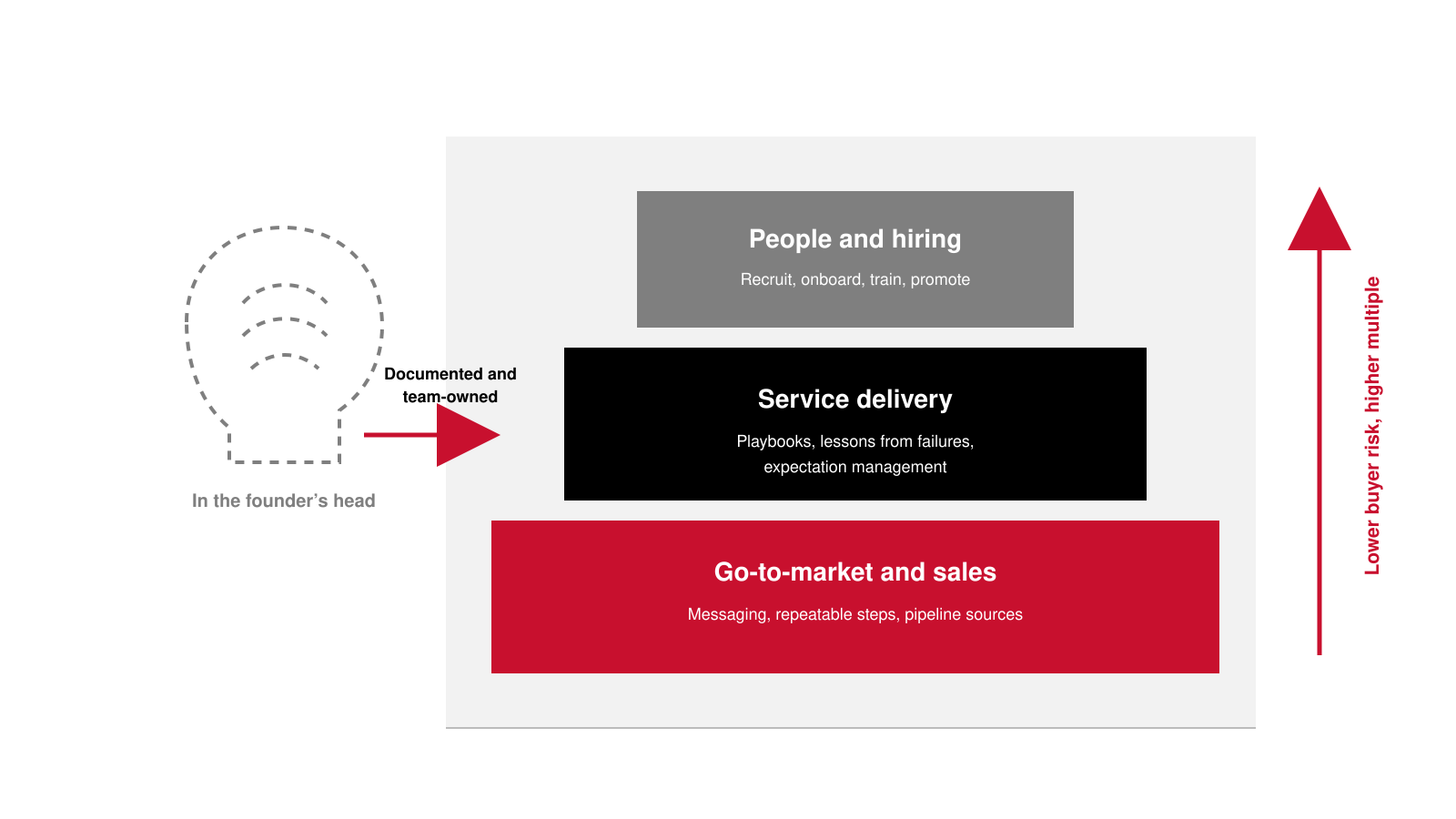
Start where the customer sits. Document your go-to-market and sales motion first, then your delivery playbooks, then how you hire and grow people. These three layers carry the most value and the most risk.
One step comes before any documentation. You have to decide that you want to grow the business, and that you will let other people help.
“If you want to grow the business, you need to let other people help you grow the business.”
Raising people up means bringing your team into the writing, not handing them a finished binder. The sales motion is usually the least understood layer, and it drives everything downstream. Capture how you win: the messaging that works, the go-to-market steps, and the way you make the sale repeatable. Then map delivery: the playbooks, the lessons from past failures, and how you manage customer expectations. Finally, document how you hire, onboard, and grow people. As Matt recalled on the episode, a tech services business is “easy to start but really hard to do.” The people layer is where scale either holds or breaks.
This work is the heart of sell-side readiness, and it pays off whether or not you sell this year.
How does documenting your business increase enterprise value?
Documented, repeatable processes raise enterprise value because they lower the buyer’s perceived risk. Repeatability and predictability read as quality. A business a buyer can integrate and scale is worth more than one that depends on its founder. This is one of the clearest levers in IT services M&A.
Think about the buyer’s math. A buyer paying a meaningful multiple, generally north of 5 times EBITDA, is not paying for last year’s revenue. They are underwriting future scale. This is how buyers approach mergers and acquisitions: they pay for the certainty of future cash flows, not the past. Their thesis assumes synergies, where one plus one equals three, and that thesis needs a business they can absorb.
“If you’re a seller and you’ve got all that done and it’s already baked and it can be analyzed in a diligence phase, you will achieve a higher multiple and enterprise value multiple, no question.”
Documentation is what makes the business absorbable. When your operating model is baked and can be analyzed in diligence, the buyer sees a clear path to scale. That clarity supports a higher enterprise value multiple, and it gives you more room to negotiate. Predictable, documented operations are central to what drives the valuation of an IT services company.
The same discipline lets you productize your services. Productized services are easy to buy and easy to repeat, which is why they command stronger multiples. Recurring revenue reinforces the effect. Businesses with 70 to 80 percent or more recurring revenue tend to reach the higher end of the range. Renewal rates above 90 percent reinforce it.
Free benchmark
Curious where your business would land today? See how your multiple moves as owner dependency comes down.
A benchmark against current market comparables, not a multiple you heard at a conference.
Run the valuation calculator →
No call · No form · No conversation
Where do AI tools fit into documenting your processes?
AI has collapsed the cost of process documentation. What used to take weeks of workflow mapping now takes a fraction of the effort. You can capture your real process, not an idealized one, and then improve it.
Start by documenting how the work actually happens. Then use AI to optimize and align the process, and to build tools and agents around it. Old operating manuals get a second life as living systems your team can prompt and update.
The payoff is repeatability that a buyer can verify. Mike’s shorthand on the episode: “repeatability, predictability, equal to higher multiple.” When the model is documented, proven, and supported by tools, perceived risk drops. That is a direct input to a higher multiple.
How do you build a culture that keeps the playbook current?
Documentation only holds value if it stays current. The fix is cultural: build adaptability into how your team works. The most expensive words in business are “that’s the way we do it.”
Change is constant. Customers change, people change, and services evolve. Some processes stay static, like your annual benefits renewal. Others change often, like new service bundles and solutions.
Encourage innovation, and hold innovators to one rule: document what you build. Leaders who bring new offerings to market should bring their teams into the writing. Celebrate a culture of innovation paired with a culture of scale.
Owners who do this get two wins. The business grows while you prepare, and it becomes far easier to transfer when you are ready. Reducing owner dependency is not a last-quarter scramble. We treat it as part of a 12 to 24 month exit preparation window. In IT services M&A, that preparation is what separates a premium exit from an average one.
Revenue Rocket is a sell-side and buy-side M&A advisory firm with 25+ years in the sector. We work exclusively with IT services companies: MSPs, cybersecurity, cloud, custom application development, and VARs. We help founders reduce owner dependency, document the business, and go to market from a position of strength.
Ready to understand what your business is worth once it runs without you?
Schedule a confidential conversation →
We will talk through your goals, your timing, and what your business could command in today’s market.
Hear the full conversation on Shoot the Moon, where Mike, Ryan, and Matt work through getting the business out of the founder’s head, episode two of their masterclass on running the firm beyond yourself.
Owner dependency in IT services M&A: frequently asked questions
What is owner dependency in an MSP or IT services business?
Owner dependency is when the company’s key relationships, decisions, and know-how live in the founder’s head rather than in documented systems. Buyers treat it as a single point of failure and discount for it.
How does getting the business out of your head affect valuation?
It raises valuation by lowering the buyer’s perceived risk and making the business easier to integrate. Repeatability and predictability read as lower risk, which supports a higher multiple and enterprise value.
What should an owner document first?
Start with the go-to-market and sales motion, then delivery playbooks, then how you hire and grow people. Put the customer at the center and bring your team into the writing so the knowledge lives in the organization.
How long does it take to reduce owner dependency before a sale?
Treat it as part of a 12 to 24 month exit preparation window. Some fixes are quick, like cleaning up customer and revenue files, while building a documented, team-owned operating model takes longer but is very doable.
Can AI help document business processes?
Yes. AI tools capture your real process quickly, help you optimize it, and let you build agents around it, turning static manuals into living operating systems your team can prompt.
Does reducing owner dependency really increase the sale price?
Yes. Buyers underwriting scale need a business they can run and grow without the founder, so a documented, transferable business earns a higher multiple and gives the seller more negotiating room.
“`