



24 Sep M&A Advisor vs. Investment Bank: Picking the Right Partner for Your IT Services Deal
Suppose you’re an IT services founder eyeing an exit (or a strategic acquisition). In that case, you’ll quickly run into a fork in the road: hire an operator-led M&A advisor or a traditional investment bank (or a third, riskier option, running a process without help). Same end goal, very different playbooks.
Here’s how we approach this significant decision, based on decades of experience in running targeted processes for IT services companies.
What an M&A advisor actually does
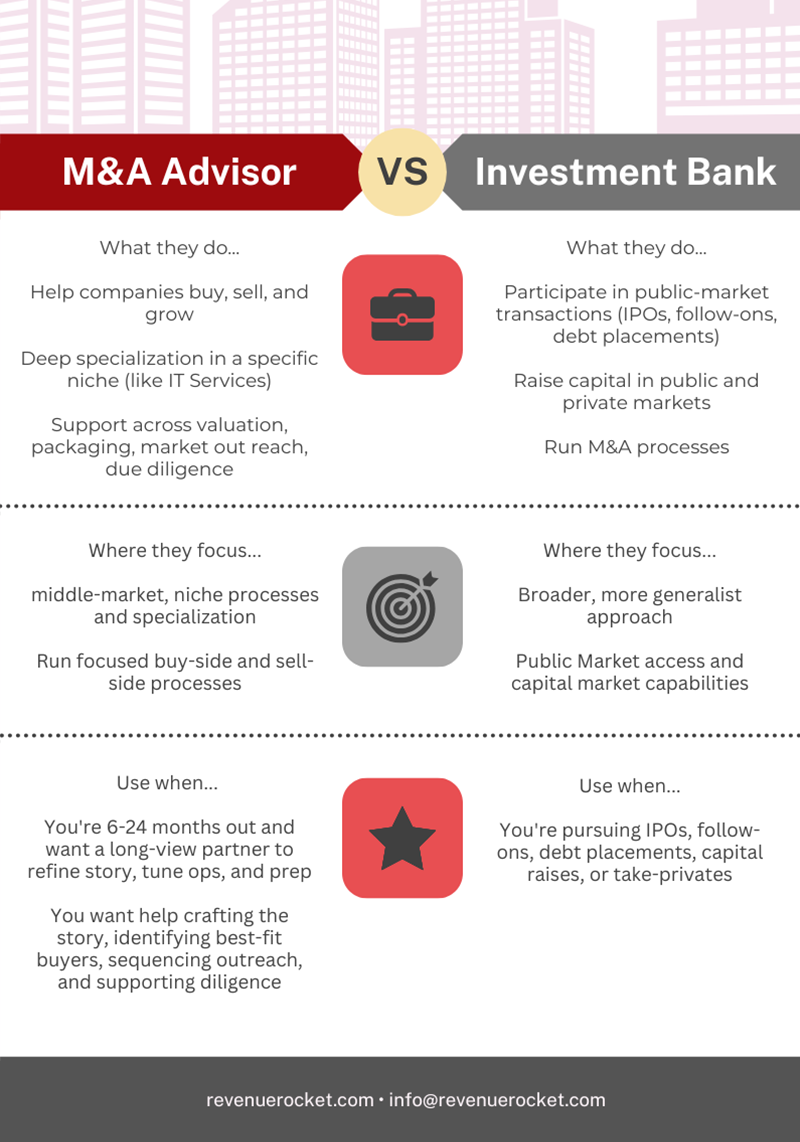
An M&A advisor is built to help companies sell or buy companies from start to finish. The good ones are deep industry specialists: they know your sub-sector, how buyers value your specific service lines, and which narratives actually move the number. Expect hands-on help across:
- Value story and positioning
- Packaging (CIM, metrics, KPI normalization)
- Creating IPPs (Ideal Prospect Profiles)
- Curated buyer list and outreach sequencing
- Deal pacing, diligence prep, and close support
- Focusing on Strategic Fit and Cultural Fit (not just financial fit)
[/vc_column_text]
What an investment bank is optimized for
Banks are excellent at capital markets work: IPOs, follow-ons, debt placements, take-privates, and large, complex transactions. Many also run M&A. Their advantage is balance-sheet breadth and distribution; their center of gravity tends to be broader and more finance-led.
Short version: Advisors = specialization + operator lens.
Banks = distribution + capital markets muscle.
In Tech Services, Specialization Wins.
IT services deals are about pattern recognition: customer concentration, gross margin mix, talent model, partner ecosystems, recurring vs. project revenue, and delivery risk. Niche advisors live here daily and can pre-empt issues before they show up in diligence. That usually means cleaner processes, fewer surprises, and higher certainty of close.
“If you get strategic fit and cultural fit right, you can almost always find a path on the financial fit.” - Mike Harvath, Revenue Rocket CEO
We always start with fit before price:
-
Strategic fit: complementarity of offerings, geography, customer overlap, and platform logic
-
Cultural fit: leadership style, operating cadence, and approach to customers and teams
-
Financial fit: structure, price, and working capital that make the deal work
Lead with price and you risk “winning” the wrong deal.
The Long-view Advantage (start early)
The best exits start 6–24 months before you go to market. Revenue Rocket understands the decision to enter an acquisition process is incredibly daunting for IT services leaders which is why we offer M&A readiness programs to get tech services leaders started early. With thorough analysis and consultation, Revenue Rocket takes the uncertainty away and helps you get ready for an acquisition or prepare your firm for the best result in being acquired.
A long-view M&A advisor like Revenue Rocket helps you:
- Tighten the value story (what buyers will actually pay for)
- Tune margins and revenue mix (recurring, managed, higher-margin offerings)
- Prepare leadership & teams for next steps
- Clean KPIs and add diligence-ready reporting
- Map a realistic buyer universe and pre-qualify fit
- Help Productize your offerings
When the moment is right, you’re ready, and the process runs faster with fewer distractions to the business.
When a bank might be the better fit
Choose a bank when your priority is capital markets or large, complex, multi-track situations:
- IPOs, follow-ons, or significant debt raises
- Take-privates or very large roll-ups
- Cross-border transactions where balance sheet and broad distribution are the main levers
How to choose: a founder’s checklist
Use this to intro any partner, advisor or bank:
Experience & focus
- Recent, referenceable IT services deals in the last 24 months
- Clear POV on your service lines, margin drivers, and buyer theses
Process & staffing
- A process calendar (prep → outreach → IOIs → LOI → diligence → close)
- Names, roles, and who’s actually doing the work day-to-day
- A first-pass buyer list with rationale (strategics, PE-backed, hybrids)
Fees & alignment
- Understanding the M&A fees
- How they’ll manage working capital, earn-outs, and structure negotiations post-LOI
- Communication cadence, standing bi-weekly and fast escalation when things heat up
Red flags
- Generalist posture and vague buyer universe
- Heavy retainers, light deliverables
- Long, one-sided tails and exclusivity
- No plan for diligence readiness
The bottom line
Pick the partner who maximizes certainty of close, cultural alignment, and net proceedsl not just the biggest logo. In IT services, specialization and operator-led execution usually outperform spray-and-pray distribution. Our biggest advice: don’t try and go it alone as the road to a successful deal is filled with unexpected turns.
Thinking about a process in the next 6-18 months? Book a 20-minute call to pressure-test your path to market.