


05 Jun M&A Myths That Cost IT Services Founders the Most
The M&A Myths That Cost IT Services Founders the Most
In IT services M&A, most founders have heard at least one version of the story. A peer sold for a jaw-dropping multiple and timed the market perfectly. They avoided earnouts entirely and walked away with a check that covered everything they’d ever need. The deal sounded clean and simple.
Real transactions almost never are.
We’ve spent 25+ years in IT services M&A, advising MSPs, cybersecurity firms, cloud providers, VARs, and digital transformation businesses in the lower middle market. The M&A myths that cause the most damage almost always arrive secondhand. They come from a friend’s deal story, one missing every piece of context that made it what it was.
Here are the five we encounter most often, and what’s actually true.
M&A Myth 1: “My Friend Sold for X EBITDA: That’s My Benchmark”
The story is almost always real. The context almost never travels with it.
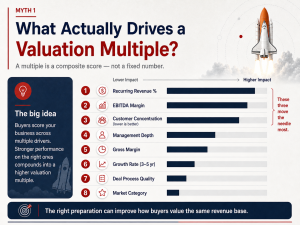
When an IT services owner hears that a peer sold for five, six, or seven times EBITDA, that number gets stored as a benchmark. But a multiple without context is not a valuation. It’s a data point missing every variable that actually drove it.
Those variables include the size of the business and the quality and predictability of its recurring revenue. They include customer concentration risk, management depth, and gross margin profile. And they include growth rate over three to five years and the competitive dynamics of the sale process itself. Two companies with identical revenue can trade at very different multiples depending on how they score across those dimensions.
Before anchoring to a number from someone else’s deal, get a real valuation, one based on your actual financials, your market position, and what buyers in your specific category have paid for comparable businesses.
M&A Myth 2: “PE Will Pay More” (Or “Strategics Always Win on Price”)
The debate over whether financial buyers or strategic buyers pay more is one of the most persistent myths in lower-middle-market M&A. The short answer: neither is predictably higher.
The longer answer is that the line between PE and strategic has blurred considerably. PE-backed strategics (companies with private equity ownership operating as strategic acquirers) are now a significant portion of the buyer universe in IT services. Categorizing a deal as “PE” or “strategic” no longer tells you much about pricing potential.
What actually determines who pays more comes down to a few things. The first is how clearly the buyer sees a path to return on their investment. The second is how much competitive tension exists in the sale process. The third is how well the seller’s story is positioned. The last is whether the buyer has developed genuine conviction that this specific company is worth paying up for.
That conviction can develop with a PE firm just as easily as with a strategic buyer. Generating it requires a structured, competitive sale process, with multiple qualified buyers engaged simultaneously, each aware that others are at the table. That kind of tension is built deliberately. It doesn’t happen through a cold inbound call or a single casual conversation.
M&A Myth 3: “Earnouts Are a Trap”
Earnouts have a reputation problem. The bad stories are real. There are cases where earnout milestones were poorly defined. In others, post-close dynamics shifted in ways that made targets unreachable. And sometimes buyers and sellers operated with entirely different interpretations of the same agreement.
But those cases are a product of poor structure, not a fundamental flaw in the instrument.
When an earnout is designed with aligned interests, it functions as a gain-share. That means clear, measurable targets that both parties genuinely want to hit. It also means a structure that incentivizes the buyer to support the seller in reaching them. If the business continues to grow at the pace the seller believes it will, an earnout represents additional upside, not a penalty.
Earnouts are also a natural mechanism for bridging a valuation gap. When there has been accelerated growth in the business and a seller is confident it will continue, an earnout allows the buyer to pay more while managing risk. That is a reasonable trade in the right circumstances.
The question to ask isn’t “are earnouts bad?” It’s “is this earnout structured correctly?”
M&A Myth 4: “I Need to Wait for the Right Market Conditions”
Trying to time the sale of your company the way you might time a stock trade is one of the most common and most costly mistakes IT services founders make.
The reason it backfires: buyers don’t value IT services businesses on a single year of performance. A credible valuation involves a look-back period of three to five years. It incorporates weighted averages on revenue and profit, discounted cash flow on forward projections, and comparable transaction data. One exceptional year does not dramatically move the needle in isolation, and neither does one difficult one.
This is actually good news for sellers. It means that a strong year on top of a consistent track record is more valuable than a spike without context. It also means macro headwinds tend to matter less than founders expect. In our experience, we have advised IT services companies through successful transactions across rising and falling rate environments. That includes periods of constrained IT budgets and significant market uncertainty. Short-term conditions rarely determine whether a well-prepared business finds a qualified buyer. But they do shape how the business story needs to be told.
What matters far more than external timing is the internal readiness of the business. That means the quality of its financials and the health of its customer relationships. It also means the depth of its leadership team and the clarity of its growth story.
When those things are in order, there will be buyers. The goal isn’t to catch the market at the perfect moment; it’s to be ready when the right opportunity appears.
M&A Myth 5: “I’m Too Small to Sell”
This one has a kernel of truth that makes it particularly sticky: size does affect what the buyer universe looks like. Smaller businesses typically attract a different set of acquirers than larger ones.
But “different” is not the same as “absent.”
There is a practical threshold. Deals tend to become genuinely competitive once a business has established meaningful recurring revenue and demonstrable EBITDA. Below that floor, the buyer universe gets thin regardless of how well the business is run. But for IT services companies that have crossed it, “too small” is almost always a preparation problem, not a scale problem.
What can actually make a company harder to sell isn’t size; it’s poor preparation. Customer concentration, founder dependency, unclear financials, and underdeveloped service delivery create more transactional friction than scale does. Picture a smaller company built with discipline, with enough management depth to run without the founder in every critical decision. It will consistently generate more buyer interest than a larger company that hasn’t done that work.
The better question isn’t “am I too small?” It’s “is the business as well-run as it could be, and do I understand what it would take to make it attractive to buyers?”
The Common Thread Across IT Services M&A
Every myth on this list shares the same root: advice that sounds like a clean rule but is missing context. As we discuss on Shoot the Moon, M&A in IT services is more nuanced than any shortcut suggests.
Revenue Rocket advises exclusively on IT services M&A: MSPs, cybersecurity firms, cloud providers, VARs, and digital transformation companies. No generalist advisory, no sideline industries. That focus is deliberate: IT services M&A has its own buyer universe, its own valuation drivers, and its own deal dynamics. Founders who work with an advisor who understands those specifics tend to get meaningfully better outcomes than those who don’t.
The most useful thing any IT services owner can do is get a real valuation based on real comparables. That holds whether a transaction is imminent or still years away. From there, you can make decisions based on facts rather than secondhand stories.
Frequently Asked Questions
What multiple should I expect for my IT services company?
There is no single answer, which is exactly the point. Multiples in IT services M&A vary widely. They turn on recurring revenue percentage, EBITDA margin, customer concentration, growth rate, management depth, and the strength of the sale process. A back-of-the-napkin multiple from a peer’s deal is not a useful benchmark. A real valuation based on current market comparables is.
Are earnouts common in IT services M&A deals?
Yes, and they are often misunderstood. Earnouts appear frequently in lower-middle-market IT services transactions. They show up especially when a business has been growing fast, or when there is a valuation gap between buyer and seller. When structured correctly, earnouts create upside for sellers without transferring all the risk. That means clear, measurable targets and aligned incentives. The bad stories come from poorly structured agreements, not from the instrument itself.
Should I sell to a PE firm or a strategic buyer?
This question has become less useful as the buyer landscape has evolved. PE-backed strategics are now a major part of the IT services buyer universe, blurring the traditional PE-vs.-strategic distinction. What matters more than buyer category is whether you run a process that generates genuine competitive tension; that determines price and terms far more reliably than choosing one buyer type over another.
How early should I start preparing to sell my IT services company?
Earlier than most founders think. The decisions that most affect your valuation: revenue mix, customer concentration, management depth, EBITDA margins, are not things you can fix quickly before a transaction. Owners who begin thinking about exit readiness 12 to 24 months ahead tend to get meaningfully better outcomes than those who wait until they are ready to move.
How long does an IT services M&A process typically take?
From initial engagement to close, a structured sell-side process in IT services typically runs six to twelve months. The range depends on business complexity, buyer responsiveness, diligence depth, and transaction structure. Building in adequate preparation time before launch is one of the most effective ways to shorten the timeline and avoid deal fatigue.
Ready to understand what your business is actually worth in today’s market?
Revenue Rocket works exclusively with IT services companies on M&A and growth strategy. If you’re thinking about your options, now or in the next few years, a confidential conversation is a useful place to start.
Schedule a confidential conversation → [SCHEDULING LINK]