


27 Jul Do You Need an M&A Advisor to Sell Your IT Services Company?
What the data says about close rates, sale price, and deal certainty when a specialist runs the process, and what changes when nobody does.
A buyer found you. The approach was flattering, the number sounded serious, and you are now three conversations into something you did not go looking for. This is how most IT services owners end up in a sale process, and it is the point at which the question arrives: do I actually need an advisor for this, or can I run it myself?
You can run it yourself. The odds and the economics both move against you when you do. Two numbers decide almost every outcome in this market. The first is the probability that your deal closes at all. The second is the price and the terms you get if it does. A specialist advisor moves both, and the first one moves further than most owners expect.
We are an M&A advisory firm, so our interest in that answer is obvious. What follows is the evidence, the sourcing behind it, and the places where the evidence is thinner than the headline suggests.
Do you need an advisor for IT services M&A?
Not legally, and not in every case. But the gap between an advised sale and a self-run one is wide enough that it should be a deliberate decision rather than a default. Roughly 20% to 30% of listed businesses ever sell. Owners who run the process alone close under 10% of the time. Businesses sold with an advisor typically transact around 20% higher than those sold owner to buyer.
A word on where these numbers come from. The close-rate and premium studies are published by BizBuySell, the International Business Brokers Association, and similar bodies, and they track more than 20 years of transaction research. They are also compiled by people who sell advisory services, which is a conflict worth naming rather than burying. Some sources put the owner-run close rate as low as 1%. We do not use that figure, because we cannot stand behind it. The credible range is under 10%, and that is the number to plan against.
What are the odds a self-managed sale actually closes?
Most businesses that go to market never sell. Depending on the source, 20% to 30% of listed businesses close, and industry bodies put the share that never close at 70% to 90%. Averaged across all sellers and all processes, only about 35% to 40% of deals get done. The best specialist advisors close 80% to 95% of the engagements they take to market. Our own close rate on engagements we take to market sits in that top tier.
A failed process is not a neutral outcome. When a deal collapses, enterprise value is zero. You are out the time, the focus, and the momentum in the business you still own.
Why do founder-led deals fall apart?
Selling a company has an art and a science to it, and self-run processes tend to fail for a short list of predictable reasons. Most of them are avoidable with preparation.
1. Unrealistic price expectations
The most common deal killer, and it usually starts secondhand. An owner hears what a friend of a friend sold for, anchors on it, and the number does not survive contact with the market. An inflated expectation kills a deal at the gate, before anyone has had a chance to defend the real value.
2. Treating M&A as a generalist task
Your attorney, your accountant and your wealth manager are all essential to a deal. None of them runs a competitive sale process for a living. Asking one to do it is like asking a dentist to perform knee surgery: skilled hands, wrong specialty. The same applies to a generalist business broker who has never sold a managed services firm.
3. Underestimating the moving parts
A sale means building the marketing materials and the message, processing NDAs, separating real buyers from pretenders, and confirming that each one can actually fund the deal. You cannot take a buyer’s word on funding. Verifying it is a job, and it is one of several running at once.
4. Losing focus on the business
The first thing we tell a client entering a process is that their number one job is still to run the company. Build pipeline, close deals, delight customers. Turn your attention from the business to the transaction and results slip, and slipping results weaken the exact numbers the buyer is underwriting.
The fix for the first one is available to you right now, before you speak to anybody. Ground the conversation in current market comparables instead of a number you heard secondhand. Running your firm through our valuation calculator takes minutes and gives you a realistic range to argue from.
How does an M&A advisor increase your sale price?
By removing the risks a buyer would otherwise price in, and by making sure more than one buyer wants the asset. Buyers are not paying for last year’s revenue. They price the certainty of your future cash flows, and they hold every claim you make up against a single question: how likely am I to actually realise this forecast? The job is to make those cash flows look as certain as they genuinely are.
The fundamentals of the mergers and acquisitions process apply in every industry. The levers that actually move an IT services number are narrower and more practical than that.
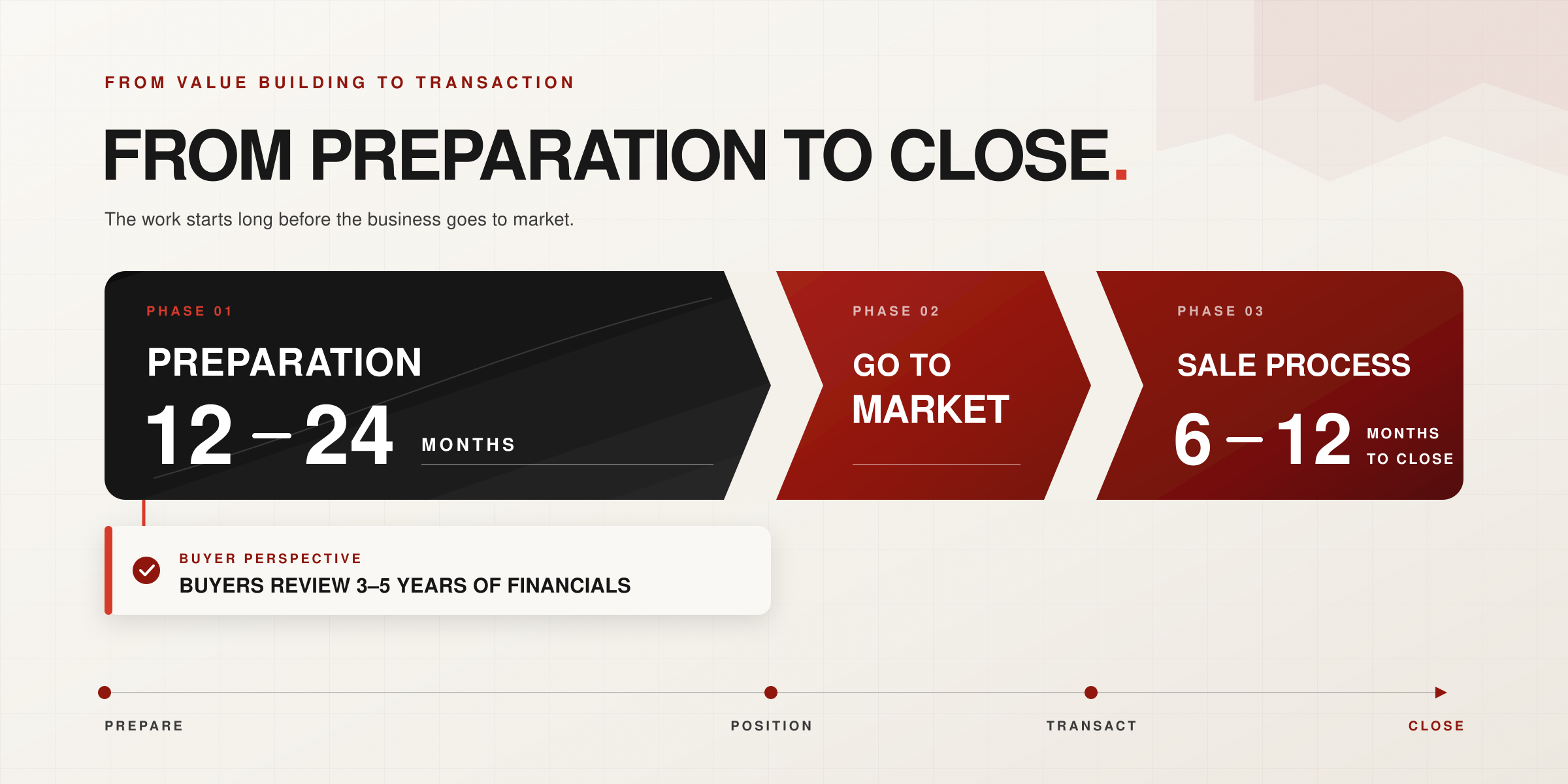
Pre-market preparation. Normalise EBITDA, make the numbers bulletproof, and find and fix the risks before a buyer sees them: customer concentration, contract risk, continuity of staff. Disciplined sell-side readiness is where the premium is earned, not at the negotiating table. Preparation typically runs 12 to 24 months, and buyers look back over three to five years of financials. Those are ranges, not rules. A clean firm moves faster; one carrying concentration or contract problems needs the full runway.
Competitive tension. A structured, competitive process puts several qualified bidders at the table at once. That is worth more than the leverage it creates on price, because bidders differ on strategic fit, cultural fit and financial fit, and you want to choose across all three rather than accept whichever one arrived first. Representing yourself to a single buyer gives that choice away.
Peer-level negotiation. You will sell a company once. A private equity or strategic buyer does this continuously, with a full team whose only job is this. An advisor is what puts a comparable team on your side of the table.
Proprietary comparables. Specialist advisors hold private-to-private comps that founders and generalist accountants cannot get to. Knowing where firms that look like yours have actually traded in recent months is the substance behind what buyers really pay for, and it is what lets you defend a number instead of asserting one.
Aligned fees, and what they cost you. Most advisors work on a retainer plus a success fee, and the retainer is usually rebated against the success fee, so nobody gets paid properly unless the deal closes well. It is fair to ask whether a roughly 20% premium survives that fee, and the honest answer is that it narrows it without erasing it. But the premium is the smaller half of the argument. The larger half is the close rate, because a process that does not finish returns nothing at all, and no fee saved compensates for that.
One more figure worth holding onto: per BizBuySell, 94% of businesses sold with an advisor in 2025 transacted at their asking price. Price expectation and price achieved converge when the expectation was set with evidence in the first place.
Free benchmark
Find out what your firm is actually worth before anyone tells you.
A benchmark against current market comparables, not a multiple you heard at a conference.
Run the valuation calculator →
No call · No form · No conversation
What makes selling an IT services company different?
Revenue quality drives valuation in this sector more than revenue size does. Before that comparison means anything, the term has to be defined, because almost everyone uses it loosely. Recurring revenue is contracted and renews on its own terms. Repeat revenue is a good customer who keeps coming back and could stop tomorrow without breaching anything. Buyers pay for the first and discount the second, and an advisor who knows the sector will make you prove which one you have before a buyer does it for you.
As a working profile, contracted revenue at 70% to 80% of the mix with renewal rates above 90% is what puts a firm at the top of the range for its size and segment. Concentration cuts the other way: when one or two clients account for 50% to 70% of revenue, buyers treat it as a risk to be priced, not a relationship to be admired. Both of these are directional benchmarks rather than promises, and where your firm actually lands is a question for someone looking at your specific numbers.
Buyers in this space have also got considerably sharper. Most bring their own advisors who know these metrics cold, which makes a specialist on your side of the table more necessary, not less. That gap widens as AI reshapes delivery economics across IT services, because the firms that can show what AI has done to their gross margins are being underwritten differently from the firms that can only say they are working on it.
Is now a good time to sell an IT services business?
For a well-run firm, yes, and a large wave of competing supply is coming. BizBuySell recorded 2,345 closed business sales in the first quarter of 2026, carrying roughly $2 billion in total enterprise value. Volume has stabilised. What has moved is the spread between the strong and the ordinary: competition intensified for well-positioned businesses with real cash flow, while demand softened for flat performers and more leveraged deals. Buyers are active, and what they are selecting for is recurring cash flow and a growth line pointing up and to the right.
Roughly 55% of owners believe they can command their price today regardless of the condition of their business. The market does not agree, and that gap is why it pays to know the signals that tell you when it is time to sell rather than waiting for a market peak that nobody rings a bell for.
Underneath all of it is a demographic wave. An estimated 12 million boomer-owned businesses holding roughly $10 trillion in assets are expected to reach the market as their owners retire. IT services firms rarely pass from one generation to the next, so most of ours will sell or recapitalise rather than transfer. As that supply arrives, buyers gain choice, and the prepared sellers are the ones who still get a competitive process.
If you are contemplating an exit in 2027 or beyond, the useful move now is not a decision. It is these three:
- Start a conversation, not a commitment. Talk to two or three advisors, learn how each of them actually runs a process, and find out what they would want changed about your business before it goes to market.
- Benchmark the number before you fall in love with one. An evidence-based range is the difference between a price you can defend in diligence and an expectation that kills the deal at the gate.
- Use the runway to get the business up and to the right. Growth and profit together, less concentration, more contracted revenue, and a leadership team that does not route everything through you.
What about the emotional side of the sale?
It is real, and it costs money. The first question we ask any owner is whether they are selling in or selling out. Selling out means a clean exit. Selling in means rolling equity and staying on to lead the next chapter, which is the more common path in IT services, and it changes what a good outcome looks like. In a sell-in deal the objective is not a signed agreement. It is a signed agreement and a working relationship that survived the negotiation.
There is pushing and shoving in every transaction. If you are going to run the business alongside your buyer on Monday, the worst possible result is arriving at the new company with battle scars, whether they are with the buyer or with yourself. A third party at the table absorbs that friction and keeps the process professional, and that is a commercial benefit rather than a comfort. In 20 plus years of deal data we can count on one hand the founders who sold alone and felt good about it afterwards. Nearly all of them said the same thing: it was harder than they expected, they thought they left money on the table, and they would use an advisor if they did it again.
Revenue Rocket is a sell-side and buy-side M&A advisory firm with 25+ years in the sector. We work exclusively with IT services companies: MSPs, cybersecurity, cloud, custom application development, and VARs.
The strongest exits start long before a deal is on the table. As a seller you want choices, and you need them to span the trifecta of strategic fit, cultural fit and financial fit in order to make the right one. Getting to that position is the work, and it takes longer than most owners think.
Ready to find out what a well-run process could add to your number?
Schedule a confidential conversation →
We will talk through your goals, your timing, and what your business could command in today’s market.
Mike, Ryan, and Matt work through the advisor question in full on Shoot the Moon, including the stats behind every figure above.
IT services M&A: frequently asked questions
Do I need an M&A advisor to sell my MSP or IT services company?
Not legally, but the data favours it heavily. Owners who sell without an advisor close under 10% of the time, while top specialists close 80% to 95% of the engagements they take to market, and advised sales transact around 20% higher. If your firm is under roughly $1M of EBITDA and a buyer you already know and trust has made a fair offer, a self-run deal is more defensible than the averages suggest. Above that, the competitive-process effect is where most of the value sits.
How much more does a company sell for with an M&A advisor?
About 20% more on average, with studies over the past two decades landing between 6% and 25%. That figure is measured on enterprise value before advisory fees, so ask any advisor to walk you from headline price down to what actually reaches your account: fees, debt payoff, escrow, working-capital true-up, and any portion held back in an earnout or rolled equity.
What percentage of listed businesses actually sell?
Around 20% to 30%. Industry bodies estimate 70% to 90% never close, and averaged across all sellers only about 35% to 40% of processes finish. These figures come from broker-industry sources, so read them with that in mind, but the direction is consistent across two decades of studies.
Can my attorney or accountant run the sale instead?
No, and you still need both of them. A transaction attorney papers the deal and a good accountant defends the quality of earnings, but neither runs a competitive sale process, sources and qualifies buyers, or holds sector comps. Relying on a generalist for that part is skilled work in the wrong field.
How long does it take to sell an MSP or IT services company?
Plan on 12 to 24 months of preparation before going to market, then roughly six to twelve months to run the process from engagement to close. A clean, well-documented firm moves faster. The single biggest cause of a long timeline is diligence surfacing something that preparation should have resolved.
What makes IT services M&A different from other industries?
Revenue quality drives value more than revenue size. Contracted, embedded managed services earn the top of the range, project and staff-augmentation revenue is discounted, and client concentration is priced as risk. Buyers here are also unusually well advised, so the metrics conversation starts at a higher level than in most sectors.
When should I start preparing my IT services company for sale?
One to two years before you want to exit. Early preparation is what lets you fix risks, grow contracted revenue, and enter the market from a position of strength instead of reacting to an unsolicited offer. Owners who start early also get to choose their moment; owners who start late take the market they are handed.