


19 Aug Hiring Your Second in Command: The Number Two That Makes You Optional
The founder who cannot step away is the founder a buyer discounts. Hiring a real second in command is how that changes, and the handover is a longer project than most owners expect.
There is a point in the life of every growing IT services firm where the founder stops being the engine and starts being the bottleneck. It rarely announces itself. Decisions queue up outside one office door, good people wait for approvals they could give themselves, and the calendar fills with work that only feels urgent because nobody else is allowed to touch it.
Buyers are not paying for last year’s revenue. They price the certainty of your future cash flows.
That certainty is exactly what a founder-dependent firm cannot offer. In IT services M&A, the presence of a capable number two is one of the few structural changes an owner can make that shows up in both the day to day running of the business and the number a buyer is willing to write. This is how to know when it is time, who to look for, and how to hand over authority without destabilising the firm.
How do you know it is time to hire a second in command?
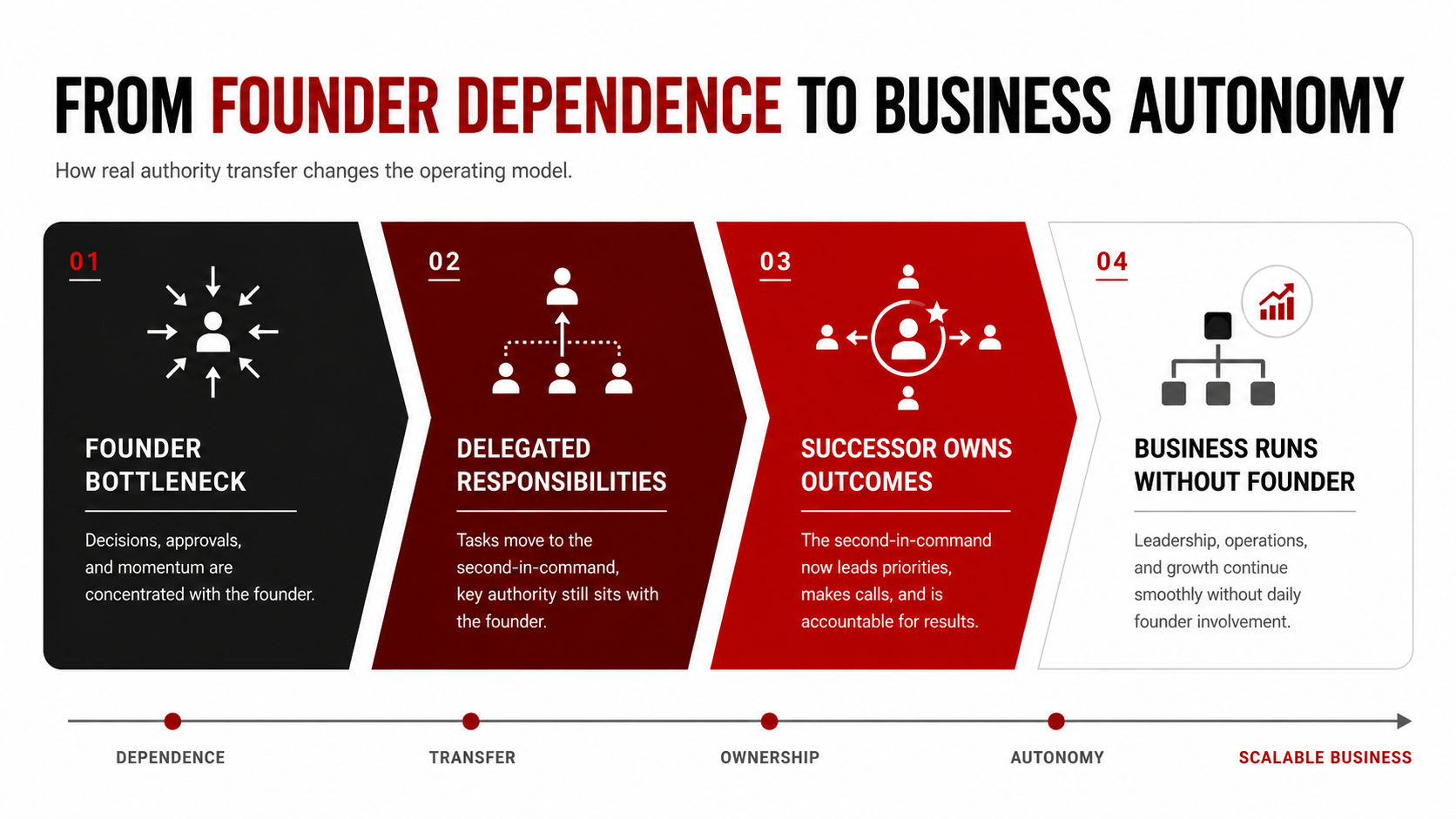
You know it is time when the business has outgrown your personal capacity to run it, not when you feel ready. Founders are usually the first employee, the first salesperson, and the first operator. That works while the firm is small. As it grows, the same person becomes a pinch point at every inflection, and the constraint stops being strategy or market and starts being hours in a day.
“Eventually the firm gets large enough where in many ways it just outgrows your ability to manage it and scale it, because there’s just not enough of you as a founder.”
The tells are practical rather than emotional. Things start slipping through cracks that used to be covered. Decisions made by other people in the business turn out to be better than the ones you would have made alone. You want to take a genuine stretch of time away and find that you cannot. Firms running on the entrepreneurial operating system will recognise the shape of this immediately: the visionary and integrator roles work fine in one person while the business is small, and stop working well before most founders admit it.
Waiting past that point is expensive in a way that compounds. Growth slows to the pace of one person’s attention, the leadership bench never develops because nobody is given room to develop it, and by the time an owner does start an exit process the firm looks structurally dependent to every buyer who reads it.
What is the difference between a senior hire and a real number two?
A senior hire runs a function. A second in command owns an outcome. The distinction matters because owners frequently believe they have solved succession by hiring a strong sales leader or a capable operations director, and then discover during diligence that no single person other than the founder is accountable for the performance of the business as a whole.
“Ultimately, that type of an individual is owning an outcome.”
In practice that means three things. The person carries a number, such as moving the growth rate from one band to the next, and is measured on it. They build the plans that get the firm there, rather than executing plans handed to them. And they are deep enough in strategic decisions that the founder can be absent from a meeting without the meeting stalling. A functional leader can be excellent and still fail every one of those tests, which is not a criticism of the hire. It is a description of a different job.
Should you promote from within or hire from outside?
Promoting from within is the preferred route in most cases, but it is a preference rather than a rule. Someone who has grown up inside the firm arrives with the history, the nuance, and the earned respect of the team. Those are the hardest things for an outsider to acquire and the most expensive things to get wrong. An external hire can still be the right answer when no internal candidate has the appetite for the role, when the designated successor chooses a different path, or when the business genuinely needs a catalyst for change rather than continuity.
One useful reference point: private equity firms bring outside leadership into portfolio companies routinely, and the results are mixed even with institutional resources behind the decision. An owner-operator carries that same risk with far less margin for error, which is a reason to develop an internal path early rather than to rule out an external hire entirely.
Free benchmark
See what your firm could be worth before you start the succession conversation.
A benchmark against current market comparables, not a multiple you heard at a conference.
Run the valuation calculator →
No call · No form · No conversation
How do you avoid the senior technician becoming CEO trap?
Promote for judgement and appetite, not for tenure or technical skill. This failure is common in smaller managed services firms, where the most obvious internal candidate is the best technician in the building. Showing up on time and doing excellent work is not the same capability as running a business, and elevating someone on that basis tends to cost the firm a great engineer and gain it a struggling executive.
Two conditions decide whether the promotion works. The first is a clear mandate. If the authority is vague, or the founder keeps reaching back over it, the role becomes impossible to perform and the person in it will either leave or shrink to fit. The second is tolerance for error, which is harder than it sounds for an owner who genuinely would have made the better call.
As Mike Harvath puts it, “you have to allow your team to make mistakes.” That is the price of building judgement in someone else, and it is the same price whether the candidate came from inside or outside. What matters more than any single decision they get wrong is whether the person is a genuine learner, because the role will keep changing shape as the firm grows.
How do you hand over authority without destabilising the firm?
Transfer visible responsibilities first, and let the organisation watch it happen. Succession fails quietly when a title changes but the actual flow of decisions does not. The team keeps routing around the new number two and back to the founder, and within a quarter everyone has concluded that the change was cosmetic.
- Hand over some of the communication. If the founder has been the voice of the firm internally and externally, giving the successor a genuine share of that is the fastest visible signal that the change is real.
- Put them into the planning, not just the reporting. Let the organisation see them setting strategy and making the calls, often alongside the founder, rather than presenting decisions made elsewhere.
- Back them publicly when you disagree privately. There is usually more than one workable path to an outcome. Visibly letting a decision stand that you would have made differently is what converts delegated authority into real authority.
- Then take real time away. A planned absence is the only honest test of whether the handover has held, and it is far better to run that test years before a transaction than during one.
What does a second in command do to your valuation?
It removes the single largest source of perceived risk in a founder-led firm. Buyers are underwriting continuity. A business where the leadership, the processes, the service differentiators, and the client relationships all survive the founder’s departure is a fundamentally different asset from one where they do not, and it is priced accordingly.
Matt Lockhart describes the pattern across both ends of the market: firms that have built that foundation and firms that have not, where the absence “has a distinct impact on the valuation because buyers are looking for firms that have these foundational pieces in place.” The foundational pieces are not exotic. They are people, process, differentiated services, and a client base that is not held together by one set of personal relationships.
There is a second return that owners tend to undervalue until they experience it. A firm that can run without you for a stretch gives you the room to work on the business rather than in it, which is where most of the strategic value gets created in the years before a sale. That is the same reasoning behind the wider case for reducing founder dependency before you sell, and it starts with getting the business out of your head and into a form other people can run.
Revenue Rocket is a sell-side and buy-side M&A advisory firm with 25+ years in the sector. We work exclusively with IT services companies: MSPs, cybersecurity, cloud, custom application development, and VARs.
There is one more argument for doing this early, and it has nothing to do with valuation. As Mike Harvath observes, “the founder’s journey is kind of a lonely one.” The worry and the risk sit with one person for years. A number two who can genuinely carry the business changes that long before it changes your multiple.
Wondering whether your leadership bench would survive a buyer’s diligence?
Schedule a confidential conversation →
We will talk through your goals, your timing, and what your business could command in today’s market.
Hear the full conversation on Shoot the Moon, where Mike, Ryan, and Matt work through what a real second in command looks like and how to hand over the reins.
IT services M&A: frequently asked questions
How long before a sale should a second in command be in place?
Treat it as part of the 12 to 24 month exit preparation window at the latest, and ideally much earlier. Buyers look back over three to five years of history, so a successor who has been running meaningful parts of the business for several years reads very differently from one appointed six weeks before the process starts. If the appointment is recent, expect questions about whether it was made for the deal.
Can a firm have more than one candidate for the role?
Yes, and it is often healthier. Several people capable of stepping up gives the founder options, gives the buyer confidence that the firm is not swapping one dependency for another, and protects the business if the designated successor leaves. The risk to manage is ambiguity: multiple candidates should not mean an unclear reporting line in the meantime.
Does the founder have to leave once a number two is in place?
No. Most founders who do this well stay and move up rather than out, taking on the strategic work they never had time for. The point of the role is optionality, not departure. A firm that can run without you is one you are free to keep running, and a buyer will read that freedom as reduced risk either way.
How do buyers actually test whether the second in command is real?
They meet them without the founder in the room, they ask who signs off on what, and they look for the founder’s name in places it should not appear, such as key client relationships, pricing approvals, and delivery escalations. Documented authority that the organisation does not actually follow is visible within a couple of management meetings.