

10 Aug The Owner Optional Firm: Reducing Founder Dependency Before You Sell
Why the companies that can run without their founder earn the strongest valuations in IT services M&A, and how to become one.
In IT services M&A, one of the largest and most avoidable discounts on a company’s value comes from owner dependency. That is when sales, delivery, key relationships, and daily decisions all run through the founder. Buyers price that dependency as risk, and risk compresses the multiple.
The companies that earn the strongest valuations can run without the owner in the room. We call that owner-optional. Becoming one is not about making yourself irrelevant. It is about making your critical roles repeatable. Then the business reads as a durable going concern, not a single point of failure.
What does owner dependency cost you in IT services M&A?
Owner dependency lowers your valuation because it concentrates risk in one person. Buyers treat a founder who controls sales, delivery, and decisions as concentration risk. It is the same logic they apply to a client worth 50 to 70% of revenue. Either one is a single point of failure that can break the business after close. In any merger or acquisition, buyers underwrite the certainty of future cash flows. A company that cannot run without its owner makes those cash flows look fragile.
“If all of the major decisions in the business have to go through the owner, then there’s going to be a single point of failure and they’re going to discount for that.”
The effect shows up in where you land within your size band. Across the market, IT services firms often trade from roughly 4 to 6x adjusted EBITDA at the smallest end. Larger, well-run platforms can reach 10 to 12x or more. Treat those figures as benchmarking ranges, not a valuation. The specifics of your business decide where inside the range you sit. Owner dependency pushes a company toward the bottom of its band. An owner-optional profile helps it compete for the top. To see what sets the number, it helps to understand what drives the valuation of an IT services company, and what buyers really pay for when they underwrite a deal.
There is a blunter way to hear it. If the answer to how anything gets done is still “go ask the owner,” a buyer is not looking at a company yet.
“You don’t have a company today. You have a job with employees.”
Free benchmark
Curious where your firm stands today?
A benchmark against current market comparables, not a multiple you heard at a conference.
Run the valuation calculator →
No call · No form · No conversation
What does an owner-optional firm actually look like?
An owner-optional firm keeps its critical functions running when the founder steps away. Those functions live in people, process, and systems, not in the owner’s head. This does not mean the owner is unimportant. No CEO is optional, and leadership is always critical. The point is that the owner’s critical roles are replaceable, either by someone promoted from inside or hired from outside.
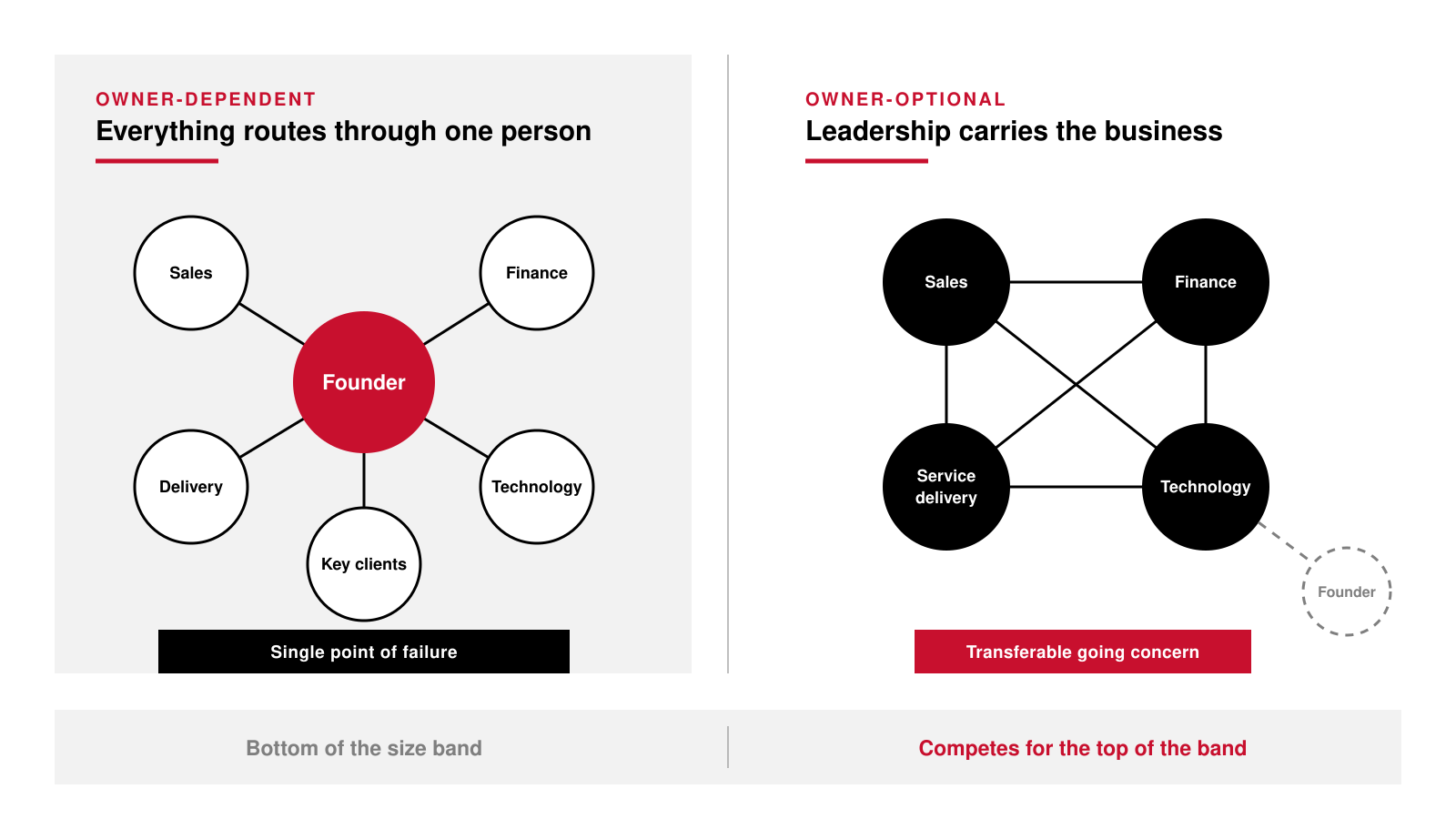
The table below shows the contrast buyers look for.
The difference is not effort. Owner-dependent founders often work harder than anyone. The difference is transferability, whether the value walks out the door when the owner does.
How do you get the business out of your head?
Before you document anything, decide that you actually want the business to grow beyond you. That is the step founders skip. Matt Lockhart puts the sequence plainly: “if you want to grow the business, you need to let other people help you grow the business.” It is an emotional decision before it is an operational one, and everything else follows from it.
Then start where the customer is. How you sell, what messaging actually works, and how you make that sale repeatable rather than personal. Next, how you deliver what you sold, including the delivery playbooks and the lessons from the jobs that went wrong. Last, how you hire and grow people, which is the part that decides whether any of it scales. Your team should co-author all three. Documentation the team wrote is documentation the team uses, and it stops the binder from going stale on a shelf.
AI has made this much cheaper than it was. Process mapping used to be a project; now the tooling can capture what your process really is, rather than the best-practice version you would have written by hand. The goal is not a document. It is, in Mike’s words, “a way to get some of that process that may be trapped in your head or in a team’s head out on paper.”
This is also where the valuation argument gets concrete. A buyer underwriting your business has to believe they can scale it, and they cannot scale what they cannot see. “If you’re a seller and you’ve got all that done and it’s already baked and it can be analyzed in a diligence phase, you will achieve a higher multiple.” Repeatability and predictability are what a buyer pays up for, because documented, proven models lower the perceived risk of everything that happens after close.
How do you transfer the founder’s sales role?
Start with sales, because in most founder-led IT services firms it is the deepest dependency. The founder was usually the first salesperson, and often the best. They have simply sold the offering longer than anyone. Only a small fraction of people can sell the way a committed founder does. The goal is to move the founder from player to coach. Build a documented sales process. Package the offerings so they are repeatable. Hire quota-carrying salespeople before you hit the ceiling, and get the founder out of every deal. If you are choosing one place to start, start with the marketing-to-sales engine. As Mike puts it, “it’s the least understood from a buyer’s perspective and one that provides a lot of concern because it drives value.” Until it is transferable, growth is capped at the founder’s personal capacity, and the revenue looks like a story rather than a system.
What leadership layer do buyers expect before a sale?
Buyers expect a leadership layer that covers the core functions of the business. Each function needs a leader with both responsibility and decision authority. At a minimum that means finance, service delivery, and sales leadership. For technical firms, it also means real technical depth beyond the founder. This leadership layer is what makes a company bankable in IT services M&A. The test is simple. For each critical function, ask whether a capable leader owns it, or whether it still runs through you. The table below outlines what good looks like.
You do not need a large team to be credible. In a smaller firm, one leader may cover two functions. What matters is that the responsibility and the authority have genuinely been handed over. The founder can weigh in without having to run every play. Promoting from inside is usually the better path, because a second in command who already carries the company’s knowledge and its trust starts further ahead than an outside hire.
How do you keep your key employees through a sale?
Retain your key people by designing retention before the deal, not during it. Your best employees carry the intellectual property of your operating model. A buyer is paying for a high-performing team that stays. Plan for that early. Common tools include retention bonuses, equity or phantom-equity participation, and targeted incentives tied to the transition. Timing matters too. Senior leaders are often brought into the process well before a transaction. Others are brought in closer to close. Bring the right people into the tent at the right time. Much of this is set through the terms of the deal, so before you go to market it is worth understanding how deal structure shapes retention and earnouts. Deals also need to line up culturally and strategically, not just financially. Employee-care philosophies on both sides have to align for the team to stay.
How long does it take to become owner-optional?
Plan on 12 to 24 months. Reducing owner dependency takes real work. It means building a leadership layer, transferring the founder’s sales role, and documenting how the business runs. Buyers want to see a track record, not a last-minute reshuffle. The sell-side process itself usually adds another six to twelve months from engagement to close. Buyers also look back over three to five years of performance, so the changes you make need time to show up in the numbers. This is why readiness is best treated as a multi-year investment. In IT services M&A, readiness is the difference between a rushed sale and a strong one. If you are weighing the timing, our guidance on knowing when it is time to sell can help, and our sell-side readiness playbook maps out the internal readiness of the business step by step.
What can you do this quarter to reduce owner dependency?
You do not have to wait for a formal process to start. Three moves pay off right away.
- Pick the area of the business that is least understood. Wherever you look around and realise nobody but you could pick it up, that is where to start documenting.
- Push decisions down and give your team room to make mistakes. Where they struggle tells you exactly where to add process, systems, or people.
- Take two weeks fully away and watch what breaks. Where the business stalls is your roadmap for what to build next.
Revenue Rocket is a sell-side and buy-side M&A advisory firm with 25+ years in the sector. We work exclusively with IT services companies: MSPs, cybersecurity, cloud, custom application development, and VARs.
Ready to understand what your business is worth, and how owner-optional it looks to a buyer?
Schedule a confidential conversation →
We will help you build the plan from owner-dependent to owner-optional.
Hear the full conversation on Shoot the Moon, where Mike, Ryan, and Matt work through getting the business out of the founder’s head, part of a master class on running your firm beyond yourself.
Frequently asked questions about owner dependency and IT services M&A
What is an owner-optional firm?
An owner-optional firm is a business whose critical functions, including sales, delivery, finance, and technical leadership, can run without the founder in the room. It does not mean the owner is unimportant. It means the owner is replaceable, which lowers the risk a buyer takes on.
Does owner dependency really lower my valuation?
Yes. Buyers price owner dependency as concentration risk, much like customer concentration where one or two clients are 50 to 70% of revenue. That risk pressures the multiple downward and can push an otherwise strong company to the bottom of its size band.
Where should I start documenting how the business runs?
Start with the customer-facing motion: how you sell, how you deliver, then how you hire and grow people. Have the team write it rather than writing it for them, because documentation the team authored is documentation the team keeps current. Modern tooling can capture what your process actually is instead of the idealised version.
How far in advance should I reduce owner dependency before selling?
Plan on 12 to 24 months. Building a leadership layer, transferring the founder’s sales role, and documenting processes takes time, and buyers want a track record rather than a last-minute reshuffle. The sell-side process itself then runs another six to twelve months.
What is the highest-value role to delegate first?
For most founder-led IT services firms, the founder’s sales role. The founder is usually the first and best salesperson, so building a documented sales process and a real team removes the single most valuable dependency and moves the founder from player to coach.
How do I keep key employees through a sale?
Design retention before the deal, not during it, using retention bonuses, equity or phantom-equity participation, and clear incentives. A high-performing team that stays is a large part of what a buyer is paying for, so bring key people into the process at the right time.
How do I test how dependent the business is on me?
Take two full weeks away and watch what breaks. Wherever the business stalls shows you which roles, processes, or systems still depend on you, and where to build next.