


26 Aug When the Numbers Live in the Owner’s Head: Financial Transparency Before a Sale
If you are the only person who can explain the numbers, you are not running a transferable business yet. You are its finance department.
In IT services M&A, nothing gets tested earlier than the books. Most founders never set out to run finance. It happened by default. You signed the first contracts. You watched the bank balance. You learned which clients paid late, and you never handed any of it off. A bookkeeper closes the month now, or an outside accounting firm does. Financial strategy still runs through one person.
Buyers are not paying for last year’s revenue. They price the certainty of your future cash flows. When the only reliable source of that certainty is the owner, it leaves when the owner does. The offer reflects it.
This is the fourth conversation in our CEO optional masterclass. Earlier entries covered getting the business out of your head and reducing founder dependency. The last one looked at hiring the number two who makes you optional. This one is narrower and more testable. It is about the financial picture of your firm, who can see it, and how fast it arrives.
Why do so many IT services CEOs end up as the de facto CFO?
Because nobody ever took the job away from them. Bookkeeping gets delegated early. It is tedious and easy to outsource. Financial strategy never does, because it feels like the founder’s judgment rather than a function. The firm ends up with clean data entry and no second brain on the interpretation.
“The real financial picture just lives in the owner’s head or in their inbox.”
The cost is not bookkeeping quality. It is the strategic decisions that never got made. Nobody was reading the trend lines early enough to act on them. At a minimum a CEO needs a sounding board, a CFO or contract CFO, to help interpret the financials and the dashboards. Do that well and the financial review seat becomes transferable. That is the whole point of the exercise.
There is an equal and opposite failure, and it shows up on introduction calls. Outsource too far and the owner loses command of their own business. As Ryan put it, “you don’t know your numbers and you’re talking to a buyer that looks just as bad.” The target is not distance from the numbers. It is shared ownership of them.
How fast should you close the books before IT services M&A diligence?
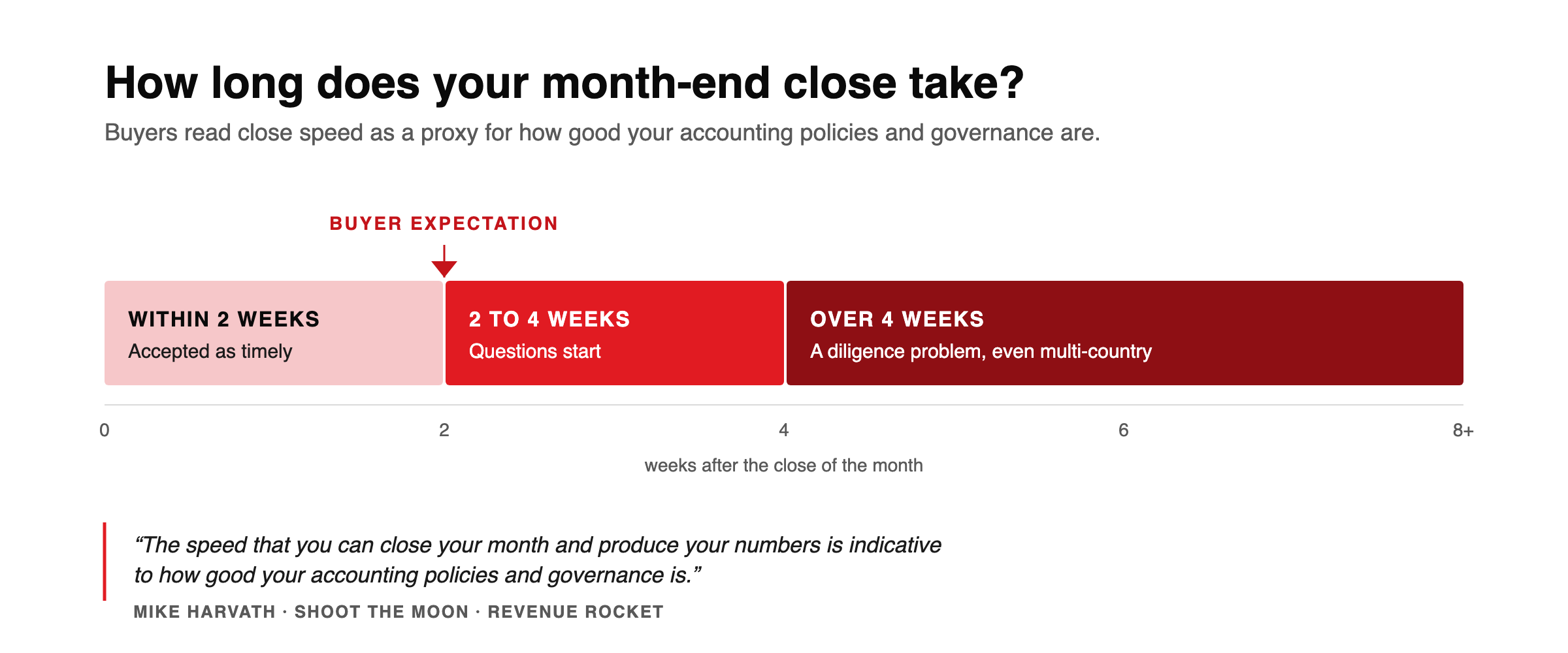
Within two weeks of month end. That is the number buyers treat as normal. Speed of close is not an accounting vanity metric. It is the cheapest available proxy for whether your policies, systems and governance actually work.
“The speed that you can close your month and produce your numbers is indicative to how good your accounting policies and governance is.”
If the close takes two months, expect questions, and expect them early. Multi currency and multi country operations complicate a close. They do not excuse a markedly delayed one.
Meanwhile the CEO still owns the headline. Revenue and profitability for any given period, off the top of their head. Everything below that line belongs to a finance team: cash flow management, and the nuance of when invoices go out and how they get collected. As Mike framed it, “they do need to know their numbers and they do need to be able to report that to a third party.”
What does good enough financial visibility look like at $5M to $50M?
GAAP based accounting is the goal, and accrual is the first real step toward it. A $3M firm does not have to adhere to every GAAP rule. But most companies start on cash basis because it is the easiest thing to do. Somewhere in the $3M to $5M range that ease turns into a ceiling.
1. Clean, current balance sheet mapped to a clean P&L
Current, reconciled, and consistent with each other. Diligence starts here, and it stalls here.
2. A standard chart of accounts with revenue lines broken out
Services, resale, recurring and one time revenue should separate without a manual exercise. Buyers value those lines very differently. A blended number invites the least generous reading.
3. Documented accounting policies
You cannot wing it on policy. Written policy is what makes revenue recognition defensible when someone else is asking the questions.
4. A budget you can map actuals and forecast against
Enter the year with a standard budget in place. Then track actuals against budget and forecast. Without the baseline, a good month and a bad month look the same.
5. Regular review by someone outside the company
Your banking relationship is the easiest version of this. Most banks welcome the conversation, because so few owners ask for it. They will tell you when something does not look straight, years before a buyer does.
Free benchmark
See what your numbers are worth before anyone asks to see them.
A benchmark against current market comparables, not a multiple you heard at a conference.
Run the valuation calculator →
No call · No form · No conversation
Which numbers should the team see, not just the CEO?
The levers that drive growth and profitability, not only the headline results. For an IT services firm that means utilization and realization. It means performance against the annual growth target and budget. And it means the shape of revenue, one time versus repeat versus recurring, because the market values those very differently.
“Having full transparency with your numbers is a best practice.”
Plenty of owners will show gross margin and stop before net income. The counterargument is simple. They are just numbers, and people who can see them are better placed to move them. Sharing the P&L and the balance sheet is also a teaching opportunity. Not everyone on your team knows how to read one, and the act of teaching builds more trust than the disclosure risks.
Measure utilization honestly. On the episode Mike put the target at roughly 80 percent against a 2,080 hour year. The common self deception is netting PTO and training out of available hours. That lets a firm convince itself it is highly utilized when it is not. Count the full year, then show where the time actually went.
“They wake up thinking, okay, what is going to drive gross margin for every customer.”
That is the standard for sales and delivery leaders. It holds for MSPs, integrators and project based firms alike. When it is missing, the bad decisions are predictable. The wrong level of personnel gets applied to the work. Discounting drifts off target pricing. Contract terms quietly wreck utilization, and therefore gross margin. Everybody in delivery should know the firm’s utilization target and their own.
What cadence keeps the numbers honest without becoming a burden?
Three rhythms, each with a different audience. You have not closed the books every two weeks. But with decent systems you can still track the levers that move fastest.
The objection to the quarterly tier is always the same. We missed, and we would rather not advertise it.
“Everybody knows anyways just by the attitude that people have.”
What are clean numbers worth in IT services M&A?
Visibility is what lets a team pull the rope in the same direction without you. That is the mechanism behind the valuation, and it shows up in specific ways. Fewer badly timed investments. Fewer missed forecasts. No end of quarter surprises. Less leakage. And a CEO who is no longer in the path of every approval. People who can see how the business operates negotiate better with vendors, and they make decisions inside their own lane instead of escalating.
- Time your close and write the number down. If it is past two weeks, that is your first project. It is a systems and policy problem before it is a staffing problem.
- Get a second brain on financial strategy. A fractional or contract CFO is enough to start. The test is whether financial review can happen with you out of the room.
- Pick the levers your team will own. Utilization, realization, gross margin by customer, and pipeline. Publish the targets, individual ones included.
- Install the three cadences. Biweekly, monthly, quarterly. Give each meeting a named owner who is not you.
- Put rigor into the forecast. Forecasting is hard, so analyze your history and your method openly with the team. Hitting forecasts is what a buyer pays a premium for, short term and long.
Revenue Rocket is a sell-side and buy-side M&A advisory firm with 25+ years in the sector. We work exclusively with IT services companies: MSPs, cybersecurity, cloud, custom application development, and VARs.
Mike’s summary of what transparency does inside a company is the one to keep. “It’s like a lubricant in many ways.” It is not a disclosure exercise, and it is not a governance box. It is the thing that lets the business run at speed when the founder steps back. That is exactly what a buyer is trying to establish before they price you.
Would your books survive a buyer’s first look?
Schedule a confidential conversation →
We will talk through your goals, your timing, and what your business could command in today’s market.
Hear the full conversation on Shoot the Moon, where Mike, Ryan, and Matt work through what it takes to get the financial picture out of the owner’s head and into the business.
IT services M&A: frequently asked questions
Do I need audited financials to sell my IT services company?
Usually not for a lower middle market deal, though it depends on the buyer. What you do need is books a third party can tie out. In practice a quality of earnings analysis, commissioned by the buyer, tends to do the work an audit would have done. It is far less painful when your chart of accounts, policies and accrual treatment are already consistent. Firms that arrive on cash basis with an undocumented chart of accounts often spend the first month of diligence rebuilding history instead of negotiating.
Should I share net income with the whole company?
Our bias is toward full transparency, because visibility is what lets people act. If you are not ready for that, share the levers your team actually controls. Gross margin, utilization, realization, pipeline. That beats stopping at revenue. What does not work is a single annual reveal. Numbers shared once a year read as an announcement, not as a tool people can use.
What is the difference between utilization and realization?
Utilization measures how much of a person’s available time is billable, against the full 2,080 hour year rather than a discounted version of it. Realization measures how much of that billable work you actually collect at rate. That is why it behaves differently in fixed fee work. If you want help deciding which one to normalize against for your delivery model, email info@revenuerocket.com.
How long does fixing financial visibility take before an IT services M&A process?
Plan on 12 to 24 months of exit preparation. The reason is arithmetic rather than effort. Buyers look back three to five years, and they want to see the discipline held for several consecutive quarters. Moving to accrual and tightening the close can happen in one quarter. Building a track record of hitting a forecast cannot.