


27 Jul Your Phone Is Ringing. That Doesn’t Mean the Deal Is Done.
Your Phone Is Ringing. That Doesn’t Mean the Deal Is Done.
An offer in hand is not a closed deal. Here is what a first offer actually binds, and how to protect your value before you respond.
In IT services M&A, a signed letter of intent binds almost nothing about price. Industry-standard LOIs are roughly 85 to 90% non-binding: the purchase price, structure, and closing conditions are all subject to change in diligence, while only a few provisions, chiefly the no-shop (exclusivity), confidentiality, and expense clauses, are legally enforceable (see a sample non-binding LOI on SEC EDGAR). So when an attractive number lands on your desk, the most important thing to understand is what you are actually holding.
If you run an IT services firm, you already know the feeling. The inbound never stops. Private equity corporate development teams, strategics, M&A advisors, proxies, even telemarketing shops all call to say they would love to buy your business. We hear it constantly from founders: “You’re the eighth person to reach out this month. I’ve just been turning everyone away.”
Then one of those calls turns into something real. You trade a few numbers, maybe send over a P&L, and a suitor comes back with an offer, sometimes a signed LOI at a number that looks great. It is easy to think the deal is basically done, and that you can take it from here or bring in an advisor at the very end just to paper it up. That instinct is understandable. It is also where a lot of value quietly leaks out of a deal.
Why does the market keep knocking?
It continues to be a seller’s market for tech-enabled services. There are more buyers than ever, and they reach out earlier, sometimes years before you are ready, to build a relationship and stay top of mind when you finally move. Founders are also more educated than they used to be, with better tools and more visibility into how a transaction works. The result is that more founders come to the table already holding an offer.
But more inbound interest is not the same thing as more value. One of the most common traps we see is mistaking interest for value. A flurry of calls and a flattering number create a kind of “happy ears” effect, and an anchoring effect around that first figure that can quietly cap what you ultimately walk away with. Most first offers are not optimized. To know whether yours is competitive, you need context for what the market would actually bear, which is exactly what a real valuation based on current comparables provides.
What does a first offer actually bind?
A first offer, even a signed LOI, binds the process, not the price. In a letter of intent, the provisions that typically bind are the no-shop clause and confidentiality, meaning your agreement not to talk to other buyers during a period of exclusivity. The value itself is not fortified. Most legitimate buyers try to honor what they put in the LOI. But it is well within the realm of possibility that a buyer tells you what you want to hear, locks you up under a no-shop, and then comes back during diligence to retrade, add structure, or push risk onto you.
A great deal is left unspecified in an LOI and surfaces later in due diligence, often enough to change the economics of a deal significantly from what is on the paper. Until a buyer digs in and drafts the binding agreement, the number you are celebrating is non-binding. As Mike Harvath, CEO of Revenue Rocket, frames it: “Buyers are not paying for last year’s revenue. They price the certainty of future cash flows, and that certainty gets tested in diligence.”
What mistakes do founders make running their own deal?
When a founder rolls their own deal, a familiar set of issues shows up. Each one is a place where value moves toward the buyer.
The first is overvaluing the business, which sets you up for a retrade when the buyer presents “comps” from their last ten deals. The second is underestimating structure: earnouts tilted toward the buyer rather than down the middle of the plate, designed so the targets are hard to hit. The third is conceding working capital. There is really only one time you can harvest your excess working capital, and that is when you sell, yet buyers routinely “land-grab” it or argue it has to stay in the business. The fourth is mishandling reps and warranties. How they are fortified, through escrow, holdback, reps and warranty insurance, or a seller note, is all negotiable and easy to get wrong alone. The last is emotional, distracted negotiation. There are more than 100 individual points to negotiate between LOI and close. Running the business while managing all of them is disruptive, and if performance dips, the buyer will use it to retrade when you are worn down.
In our experience, the probability of reaching a successful close drop meaningfully when a founder manages the process alone. One honest caveat: we do a lot of buy-side work too, and sometimes the first offer genuinely is the best one. In M&A, it only takes one. But if you are evaluating that offer yourself, you have no benchmark for what the market would bear, and no leverage if the offer should be pushed. Before you respond, it is worth running your firm through the Revenue Rocket valuation calculator to see where your number actually lands against the market.
Deal facilitation vs a full sell-side process: which fits?
Revenue Rocket offers more than one way in, because the right help depends on where your head already is. A full sell-side process and deal facilitation are different engagements with different scopes and price tags.
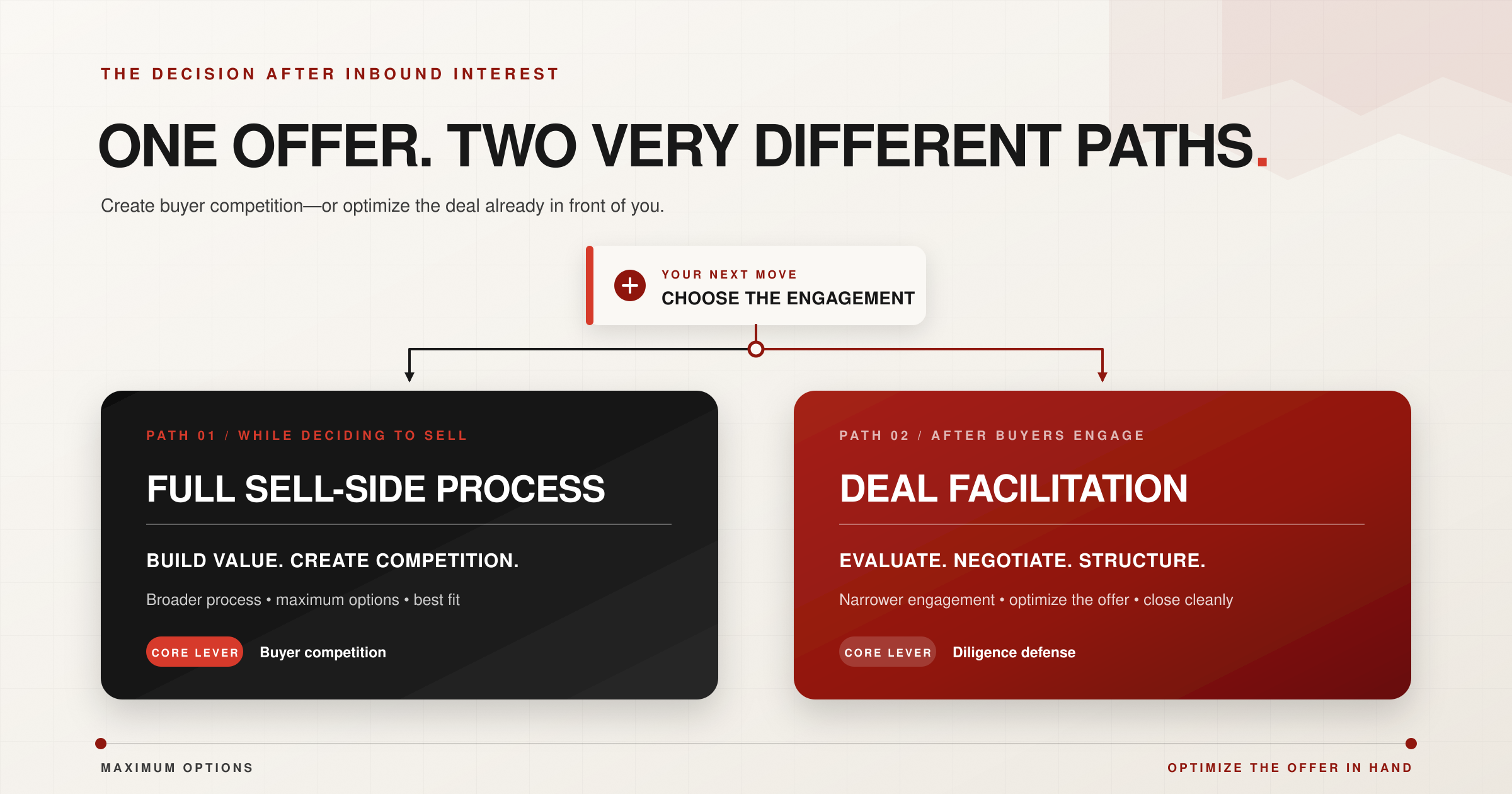
| Consideration | Full sell-side process | Deal facilitation |
|---|---|---|
| When it starts | While you are still deciding to sell | After buyers have engaged, often post-LOI |
| What it does | Builds valuation and materials, runs outreach, brings a competitive short list | Helps you evaluate, negotiate, and structure the offer in front of you |
| Core lever | Buyer competition optimizes price, terms, and fit | Diligence defense and pre-diligence on your own numbers |
| Scope and cost | Broader, higher | Narrower, lower |
| Best for | Maximum options and best fit | An offer already on the table you want closed cleanly |
A full process starts when you are still deciding to sell. We build the valuation and materials, run outreach, and bring a competitive short list of buyers to the table. That competition is what optimizes price, terms, and fit. Deal facilitation meets you where you already are: you have talked to buyers, the market has spoken to your value, maybe you have already signed an LOI. We are not running a full auction. We help you evaluate, negotiate, and structure the opportunity in front of you and get it cleanly to close, including diligence defense and pre-diligence on your own numbers so issues get caught before a buyer uses them to erode your price.
We do not put our thumb on the scale. If you want maximum options and the best fit, a full process is usually better. We have had facilitation engagements where we determined the buyer was not right, and the client went back to another buyer, ran a full process, or used the time to improve the business instead. The point is to get help at the right moment for you. These are exactly the trade-offs Mike, Ryan, and Matt work through on Shoot the Moon.
Do you lose control if you bring in an advisor?
No. An advisor does not take control of the process. You make every final decision. What an experienced third party adds is leverage. As we cover in why selling a tech services company requires an advisory team, it takes a village to close a deal: your attorney, your CPA or tax advisor, and someone who has managed the buyer-side negotiation many times. We are an addition to your team, not a replacement for you. Advisors do not take control. They add leverage, and that is the leverage you do not get on your own.
An offer just landed. What should you do first?
Do not engage emotionally, and do not start spending the proceeds in your head. Take four steps before you respond. First, validate the buyer: their credibility, their certainty to close, and their story. Second, make sure the buyer aligns with what you actually want for your employees and customers. Third, decide whether you want to sell in or sell out, and whether you want to stay on. Fourth, talk to an M&A advisor, whether that is us or one of our peers, before you respond. A single conversation can help you pressure-test the offer, understand the buyer, and protect your optionality.
Revenue Rocket is a sell-side and buy-side M&A advisory firm focused exclusively on IT services companies, including MSPs, cybersecurity, cloud, custom application development, and VARs, with 25+ years of experience in the sector. We have sat on both sides of the table enough times to know where first offers tend to bend, and where a founder negotiating alone tends to give ground without realizing it.
If an offer just landed, the most valuable thing you can do is understand what it is really worth before you respond, while you still have the leverage to shape it. That is the conversation we have every week, and it is the one that protects the most value. The earlier you have it, the more options stay open to you. So before you reply to that buyer, schedule a confidential conversation with the Revenue Rocket team. If you have an offer in hand, or several, we would welcome the call.
Frequently asked questions
Is a signed LOI binding in IT services M&A?
Mostly no. A typical letter of intent is roughly 85 to 90% non-binding. The purchase price, deal structure, and closing conditions can all change in diligence. Only specific provisions, usually the no-shop (exclusivity), confidentiality, and expense clauses, are legally enforceable.
Do I need an M&A advisor if I already have an offer?
Not always, but it is the lowest-risk first step. Even with an offer in hand, you lack a benchmark for what the market would bear and leverage to push the terms. An advisor can pressure-test the offer, defend diligence, and structure the deal, often through a narrower deal facilitation engagement rather than a full process.
What is the difference between deal facilitation and a full sell-side process?
A full sell-side process starts before you commit to sell and runs competitive outreach to optimize price, terms, and fit. Deal facilitation starts after a buyer has engaged, often post-LOI, and focuses on evaluating, negotiating, and structuring the specific offer to a clean close. Facilitation is narrower in scope and lower in cost.
Will hiring an advisor make me lose control of the deal?
No. The advisor runs the buyer-side negotiation and coordinates the team, but the founder makes every final decision. The value an advisor adds is leverage and process discipline, not control.
Why are first offers usually not the best offers?
Most first offers are not optimized because there is no competition behind them. A single buyer has no incentive to bid against itself, and a flattering number creates an anchoring effect that can cap the final outcome. Sometimes the first offer is genuinely the best, but you cannot know that without market context.
How long does a sell-side process take?
A full sell-side process typically runs six to twelve months from engagement to close. Building advisor relationships 12 to 24 months ahead of going to market gives founders the strongest position.
Schedule a confidential conversation → [SCHEDULING LINK]