


30 Jul When Your Platform Partner Changes the Rules: What It Means for Your Company’s Value
Vendors optimize for vendors. Here is what platform dependence actually reveals about your business, how buyers price it, and what the most acquirable IT services firms do differently.
In IT services M&A, heavy dependence on a single platform or channel partner is rarely the real problem. It is the symptom. The underlying condition is a business that never built a demand engine it owns.
Buyers are not paying for last year’s revenue. They price the certainty of your future cash flows. A vendor can rewrite its pricing, collapse its partner tiers, or redirect your leads, and when it does, the certainty sits outside your control. Acquirers price that the way they price heavy customer concentration.
Mike Harvath, CEO of Revenue Rocket, puts the dynamic plainly: “The vendors will always do what’s best for the vendors, first and foremost. And sometimes that means rolling a car over the channel.”
But here is the part that gets lost in the alarm. A program change does not destroy a good business. It exposes a fragile one. Firms with top-quartile growth and profit stay sellable through every ecosystem shift we have seen. The firms that get hurt were already dependent on someone else’s demand, and the program change simply made it visible.
So the useful question is not what the vendor will do next. It is how much of your value depends on decisions you do not make, and that is a question you can actually measure.
Platform partnerships built much of this industry and they still matter. But in our 25+ years advising IT services firms, we have watched the balance of power shift steadily toward the vendor.
What happens to your valuation when a platform partner changes the rules?
The immediate hit is operational. The lasting hit is to your valuation.
Picture a firm whose leads, pricing, and go-to-market all flow through one platform. In a buyer’s eyes, that is a firm whose revenue can be switched off by a third party. Buyers underwrite the durability of cash flow, so single-source reliance reads as concentration risk. It is the same lens behind what buyers really pay for: predictable, diversified, recurring revenue.
“Those same vendors will always do what’s in the best interest of their business as a vendor, versus a channel. That’s just a given. They oftentimes have stockholders to report to.”
The discount rarely shows up as a lower headline number. It shows up in structure. More of the consideration moves into a contingent earnout. The escrow or holdback gets larger. The reps and warranties around partner agreements get tighter. Your enterprise value can look fine on the term sheet while your cash at close moves materially. That is the number that matters.
Three numbers, not one: measuring your actual exposure
Most owners answer “how dependent are you?” with a single revenue percentage. That is not enough, because three different concentrations carry three different risks, and buyers price them very differently.
1. Revenue concentration
What share of top-line revenue flows through one vendor’s products or program? This is the number everyone quotes and the least informative of the three. A firm running 70% of revenue through one vendor as low-margin resale is exposed on paper but may have little real value at stake.
2. Gross-profit concentration
What share of gross profit does that same vendor represent? This is the number a buyer actually models. If 70% of revenue is one vendor but only 15% of gross profit, the exposure is far smaller than the headline suggests, because the value was never living there. If revenue and gross profit are both concentrated, the risk is real.
3. Pipeline concentration
What share of new opportunities originates from partner-supplied leads? This is the one that should worry you most, and almost nobody measures it. Revenue concentration describes where you have been. Pipeline concentration describes whether you have a business next year without the vendor’s help.
Run all three before you conclude anything. Across the deals we see, the gap between the revenue number and the pipeline number is usually where the real story is. Mike’s rule on this has not changed in years: “You should not rely on or build your business solely on vendor leads. You need to be able to hunt-source new opportunities within your customer base yourself.”
Free benchmark
See where your number lands before a vendor decides it for you.
A benchmark against current market comparables, not a multiple you heard at a conference.
Run the valuation calculator →
No call · No form · No conversation
Why do buyers treat vendor dependency as a risk in IT services M&A?
Because it hands control of your future revenue to a company whose first duty is to its own shareholders. A vendor will always act in its own interest. That is not cynicism. It is structure.
And the direction of travel has been consistent for two decades. This is Mike’s read across that whole period:
“I haven’t seen many vendors over the last 20 years or so dramatically increase their payments to partners. Typically, all these programs have gone one way, and that’s been to reduce the number of partners, encourage consolidation in the channel, and reduce remuneration.”
On where that ends up, he is blunt: “Eventually those channel commissions will go away. I believe that to my core. We’ve seen it happen with many vendors.”
Ryan Barnett points to the pattern playing out in a specific ecosystem: “We’ve seen all these Salesforce partners that came in. They changed the program from five different levels to two.” The effect on everyone below the line is the part owners feel: “Now only the top tier partners are getting support, and the rest are starting to wash up.”
A business built on reselling and partner leads is therefore exposed on two fronts. The economics can shrink, and the demand can be redirected. Matt Lockhart reduces it to a single line: “The more dependent you are, the more you are at risk.”
| How a buyer sees two similar firms | Single-vendor-dependent firm | Diversified, demand-owning firm |
|---|---|---|
| Lead generation | Relies on partner-supplied leads | Generates its own pipeline; partner leads are upside |
| Pricing power | Set by the vendor program and its margins | Set by its own expertise and outcomes |
| Exposure to a program change | High; a tier change can reset the business | Low; absorbed across vendors and direct demand |
| Revenue quality | Often tied to one product lifecycle | Spread across services and platforms |
| Buyer perception | Concentration risk, discounted | Durable cash flows, premium candidate |
Which buyers discount vendor dependency, and which one might pay for it?
This is where most advice on the subject goes wrong. “Buyers discount dependency” is true of most buyers, not all of them, and the exception matters.
Financial buyers discount it, consistently
A private equity platform underwrites the durability of cash flow over a five-to-seven-year hold. Anything a third party can switch off is a risk to be priced, structured around, or avoided. Expect a lower multiple, a heavier earnout, or both.
A strategic inside that ecosystem may value it highly
If a buyer is consolidating tier status, program economics, or certified headcount within the same vendor’s ecosystem, your partner standing can be among the most valuable things you own. As Mike puts it, becoming “a preferred partner or special class partner within a single vendor ecosystem… gives you some more fortification.” Ryan makes the M&A version of the point: “That specialty is also what makes you really attractive to the right suitor at the right time.”
So is dependency fine if a strategic is your likely buyer? No, and this is the point worth internalizing.
Dependency does not just risk a discount. It shrinks the number of bidders who can credibly compete for you.
Price in a sale is set by competitive tension. Take financial buyers off the table and you are left with a narrow set of strategics inside one ecosystem, who know they are the only credible bidders and who will price accordingly. The single strategic who values your tier status is also the strategic who knows nobody else is bidding. You will hear a good story about strategic fit and see it reflected nowhere in the terms.
Diversifying does not just protect your multiple. It restores a competitive process by keeping both buyer universes live. That is where the money is.
How much of your revenue should ride on a single vendor?
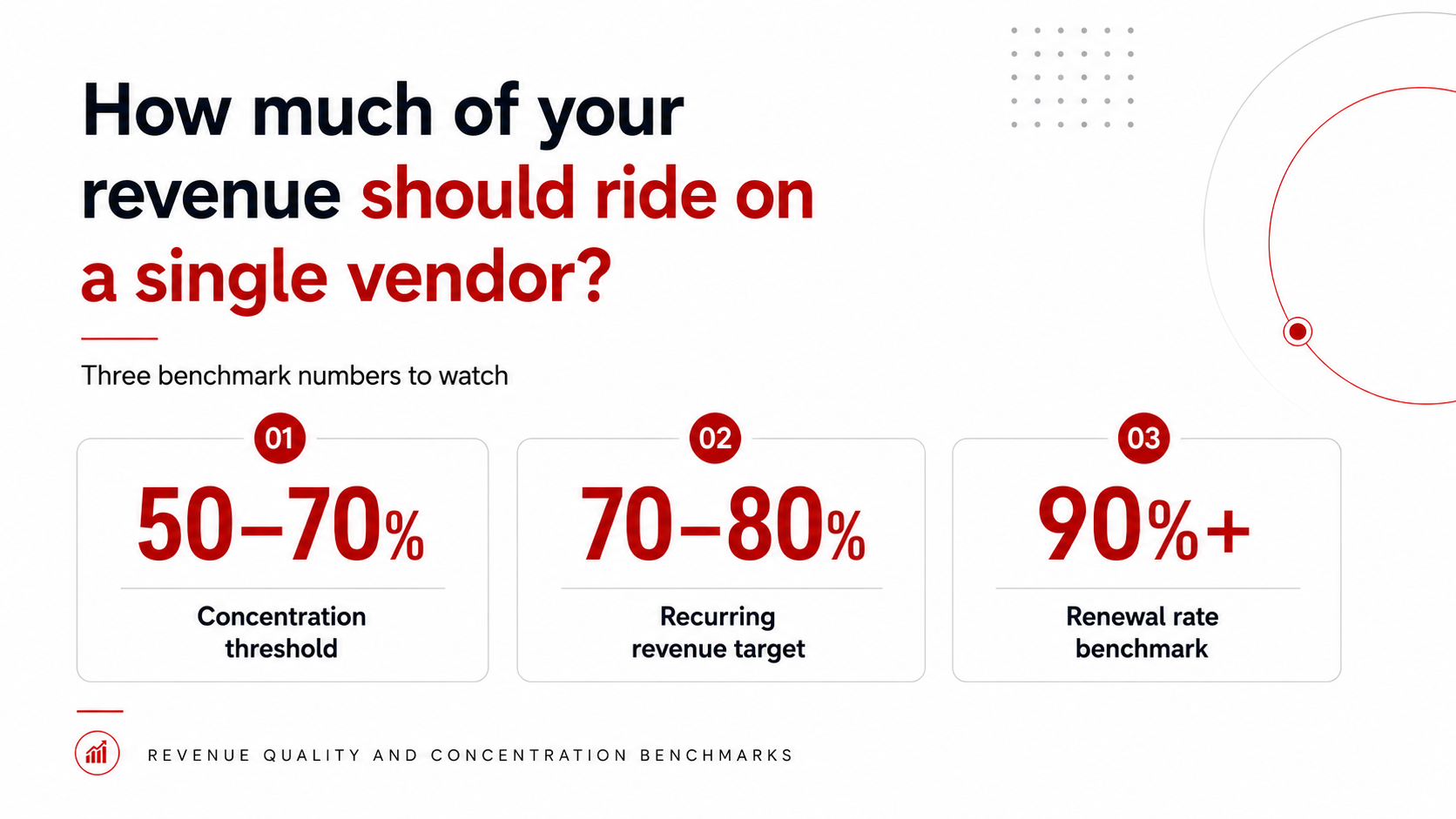
As a rule of thumb, no single vendor or client should control the majority of your revenue, your gross profit, or your pipeline. When one or two sources reach roughly 50% to 70% of revenue, most buyers treat it as concentration risk.
What buyers reward is the opposite profile: durable, diversified, high-retention revenue. In the strongest IT services firms, recurring revenue runs near 70% to 80% and renewal rates sit above 90%.
But revenue quality alone will not carry a valuation. At Revenue Rocket we use what we call the Rule of 45: three-year average top-line growth plus three-year average EBITDA margin should approach 45. It is our own internal framework, not an industry standard, and it is the fastest way we know to see whether a business is genuinely performing. A firm can diversify across five vendors, own its demand, and still fall well short of 45. Vendor mix modifies the multiple. Profitable growth sets it.
Before you plan around any number, ground the conversation in a real valuation based on current comparables, not a multiple you heard at a conference.
Does verticalization reduce platform dependency?
It does, but treating that as the reason to verticalize gets the logic backwards.
Specialize, Verticalize, Productize is a growth strategy first. We have implemented it in hundreds of IT services companies, and firms that go deep in a vertical command better pricing, win more of what they bid, and build expertise that is genuinely hard to copy. Reduced vendor dependency is a consequence of doing it well, not the objective.
The mechanism is straightforward, and Mike lays it out directly:
“If you’re really verticalized in a vertical market, you probably have the opportunity to effectively represent multiple product lines in a particular category. Many of our clients do that in particular to mitigate the risk of any particular vendor upending their program and then causing you hurt. So it becomes less risky over time for you to be verticalized, even if the lion’s share of the work you do isn’t around a single vendor and a single vendor’s partner program.”
Serving a vertical properly usually means representing several products and integrating them into one outcome, so a verticalized firm becomes multi-vendor by necessity. Expertise is the moat automation cannot easily copy. It also shapes how an IT services firm is valued.
What is the future role of the channel partner?
The durable role is the work that happens close to the customer. Mike calls it the service garage:
“Particularly in the world of AI, self-procurement will be the rule sooner than the exception, and the role of the partner becomes much more around the final mile implementation work that is sold as services, as well as what I call the service garage. Regardless of the product or platform or solution, someone needs to be around to implement it and ultimately service it and maintain it.”
What that shifts is the kind of expertise a buyer is paying for. In Mike’s framing, “in the world of AI agents, we’ll be looking less for technical competence and more for coordination efforts and functional experts.”
Ryan sees the upside in it rather than the threat: “If we move from software as a service, and partners implementing software as a service, to services as software, this could be the biggest opportunity that channel partners have ever” had. The firms closest to the customer extend platforms in ways the vendor never designed and never sees. That is work a vendor cannot easily take direct, and work a buyer will pay for.
How do partner-program changes affect IT services M&A activity?
They accelerate consolidation rather than dampening it. Mike’s view is that the underlying force was never the program in the first place: “Consolidation is sort of an immovable force in the world of IT services. We’ve seen consolidation since the market started, 40 years ago.” On what a program change does to deal flow, he is direct: “I certainly don’t see it having a dampening effect on the M&A landscape. If anything, I see it accelerating consolidation in those channels.”
Which firms stay attractive through that is, in Matt Lockhart’s words, a matter of fundamentals rather than program status: “True business principles apply. If you’re a well-run business, if you’re producing good margins, if you’re producing good profit, if you’re good at solutioning and taking care of your customers, you are going to be attractive.”
When a program changes, owners face two strategic choices. Ride it out while diversifying vendors and building direct demand. Or partner up and join a stronger platform, which is often the right move while the business is still strong. Either way, planning ahead makes the decision to sell your IT services firm far less reactive.
Timing matters. Preparing an IT services firm for sale typically takes 12 to 24 months. A sell-side process then runs roughly six to twelve months from engagement to close. Buyers usually look back three to five years. So the time to reduce vendor dependency is well before you go to market, not after the program changes.
What a buyer will ask for in diligence
Vendor exposure is not something a buyer takes your word on. The requests are specific and predictable. If you want to know how you will score, assemble these now rather than under a deadline.
- Revenue by vendor, three years, with year-over-year movement
- Gross profit by vendor, same period, the number that actually drives the model
- Pipeline and closed-won by lead source, separating partner-supplied from self-generated
- Partner agreements in full, with termination, tier-change, and exclusivity clauses flagged
- Current tier or certification status, plus the requirements to maintain it
- Renewal and retention rates, split by whether the customer originated from a partner lead
- Any written notice of program, pricing, or tier changes received in the last 24 months
If pulling this list together is difficult, that itself is a finding. Buyers read reporting quality as a proxy for how well the business is run, and messy financials get priced accordingly.
What should you do about it now?
You cannot control what a vendor does next. You can control how much of your valuation rides on it, and how many buyers are able to compete for you when you go to market. Four things, in order.
- Measure all three concentrations. Revenue, gross profit, and pipeline, each as a share traced back to a single program. If any of them is above half, a buyer will find it in diligence and price it.
- Build a demand engine you own. This is the slowest lever and the one that moves valuation most. Vendor leads should be upside, never the foundation.
- Deepen the expertise that makes you hard to replace. As Matt puts it, the resilient firms are “mapping what you do to provide extra value to a customer on top of somebody’s ecosystem. And if you’ve been doing that well, even if they change their program, you should be in a good position.”
- Start before you need to. Both levers above take quarters, not weeks, which is why this work belongs in the 12-to-24-month window before a sale rather than in response to a program announcement. If you are weighing whether to diversify, ride it out, or bring in an advisor to run a process, that is a phone call, not a commitment.
Revenue Rocket is a sell-side and buy-side M&A advisory firm focused exclusively on IT services companies (MSPs, cybersecurity, cloud, custom application development, and VARs) with 25+ years in the sector. We have priced vendor concentration from both sides of the table, and we have watched what happens to firms that measured it late.
The firms that come through vendor turbulence with their value intact are the ones that started before the rules changed. In Mike’s words, the durable advantage “comes from the folks that are closest to the functional expertise in the market, as well as knowing the vertical market in ways that the vendor probably can never really know.”
Ready to understand how a buyer would score your vendor exposure today?
Schedule a confidential conversation →
We will talk through your goals, your timing, and what your business could command in today’s market.
Hear the full conversation on Shoot the Moon, Episode [EP-NUMBER], where Mike, Ryan, and Matt work through what vendor program changes mean for the channel.
IT services M&A: frequently asked questions
Is it risky to build my IT services business around one platform partner?
It can be a sound strategy early on, but the risk compounds as you grow. Relying on one platform is reasonable while you build expertise. It becomes a valuation liability once your leads, pricing, and growth all depend on one vendor program. Buyers discount that dependency as concentration risk.
Which number matters most: revenue, gross profit, or pipeline concentration?
Pipeline, then gross profit, then revenue. Revenue concentration describes where you have been. Gross-profit concentration tells a buyer how much value is genuinely at risk. Pipeline concentration tells them whether you have a business next year without the vendor’s help.
Would a strategic buyer in the same ecosystem pay more for my partner status?
Possibly. Preferred or special-class status is hard to build and genuinely valuable to a consolidator inside that ecosystem. But dependency also removes financial buyers from your bidder pool, and a strategic who knows they are the only credible bidder prices accordingly. Narrowing the buyer universe usually costs more than the tier status is worth.
How do buyers view vendor or channel dependency in an acquisition?
As a threat to the durability of future cash flows. If a vendor can change pricing, tiers, or lead flow, it can reset your business. Acquirers treat that much like heavy customer concentration, and it typically shows up in structure, through a larger earnout, a bigger holdback, or tighter reps, rather than in the headline number.
Should I diversify across multiple vendors before selling?
Usually yes, though not at the expense of focus. The strongest position is deep vertical expertise that spans several complementary products, so no single vendor decision can upend the business. Verticalization tends to make a firm multi-vendor by necessity.
Do partner-program changes slow down M&A in IT services?
The opposite. They tend to accelerate consolidation, as stronger partners acquire the firms most exposed to the change. Well-run, profitable firms with good margins and strong customer relationships remain attractive regardless of how a program shifts. Program upheaval changes who buys and when, more than whether deals happen at all.
How long does it take to prepare an IT services firm for sale?
Plan on 12 to 24 months to prepare. A sell-side process then takes roughly six to twelve months from engagement to close. Buyers typically look back three to five years. So reduce vendor dependency well before you go to market.