


27 Jul Your Phone Rings Because It’s a Seller’s Market. Your First Offer Still Isn’t a Deal.
An offer in hand is not a closed deal. Here is what a first offer actually binds, and what to do before you respond.
If you run an IT services firm, you already know the feeling. The inbound never stops.
As Mike Harvath, CEO of Revenue Rocket, describes it: “Most of you out there running an IT services company know that you get lots of calls every week, and sometimes every day, from suitors looking to acquire your business. And not just suitors. You’ve got proxies, M&A advisors, telemarketing firms, corporate development departments of private equity and strategics. All these guys are fighting for your attention to say, hey, we’d love to buy your firm.”
The reason is a market condition, not a verdict on your company. There are more buyers than sellers in tech-enabled services right now. Buyers reach out earlier than they used to, sometimes years before you are ready, to build a relationship and stay top of mind. And founders are better informed than they were a decade ago, which means the conversation moves further before anyone brings in help.
We hear the same line constantly: “You’re the eighth person to reach out this month. My phone is ringing off the hook, and I’ve just had to turn everyone away.”
Then one of those calls turns into something real. You trade a few numbers, maybe send over a P&L, and a suitor comes back with an offer, sometimes a signed LOI at a number that looks great. It is easy to conclude the deal is basically done, and that you can take it from here and bring in help at the very end just to paper it up.
Mike sees that pattern constantly: “There’s this tendency where founders think they’re done before they start.”
That instinct is understandable. It is also where a lot of value quietly leaks out of a deal.
What does a first offer actually bind?
A first offer, even a signed LOI, binds the process, not the price.
“The only binding provisions typically in an LOI are the no-shop clause, which means you can’t continue to look for buyers while you’re signed under this period of exclusivity. In this LOI, the value is certainly not fortified.”
So the no-shop binds, along with confidentiality and the expense clauses. The purchase price, the deal structure, and the closing conditions do not. Those get tested in diligence.
Most legitimate buyers try to honor what they put in the LOI. But as Mike puts it, “it’s not outside the realm of possibility that you have someone who’s just telling you what you want to hear, and then their plan is to come back and retrade, or add structure, or push some risk on you.”
Even with a buyer acting in good faith, a lot goes unsaid: “There’s a lot that’s not stated typically in an LOI that will come out in due diligence, that can change that offer wildly from what’s on the paper.”
Until a buyer digs in and drafts the binding agreement, the number you are celebrating is not a number you have.
Why isn’t the first offer usually the best offer?
Because nothing is pushing on it. “Most first offers are not optimized,” Mike says. “Meaning they are simply a number, and in some cases, they’re not even real.”
Three things work against you when you evaluate an offer alone.
There is no competitive tension. A single buyer has no reason to bid against itself. In a managed process, “you get to choose between a variety of buyers, and usually a variety of price points and a variety of structures.” Matt Lockhart puts the same point more bluntly: “When there’s competition, quite honestly, it drives price.”
The experience gap runs entirely one way. The person on the other end of the call does this for a living, and you do not:
“These are not ultimately people you’re going to work with. You may be working alongside them, but you should know that their job is to go find companies to acquire and to manage that process from origination to close. And they’re professionals at that. You’re not. So you lose leverage there.”
A flattering number becomes a ceiling. A flurry of calls creates what Mike calls “happy ears,” and founders “make the mistake of interest for value.” That first figure anchors everything that follows.
One honest caveat, and it matters: Revenue Rocket does a lot of buy-side work too. Sometimes the first offer genuinely is the best one. In M&A, it only takes one. But as Ryan Barnett puts it, “if you’re evaluating that offer yourself, you really don’t have context of what the market is there.”
Knowing whether your number is competitive means understanding what actually drives the valuation of an IT services company, and what buyers are really pricing. As Mike explains it: “Buyers price future performance, not just past stories and financials put on the board. They’re trying to have a certainty of future cash flows to get a return on investment.”
Free benchmark
You can check your own number right now, without talking to anyone.
Just a benchmark against the market before you reply to that buyer.
Run the valuation calculator →
No call · No form · No conversation
What mistakes do founders make running their own deal?
When a founder rolls their own deal, a familiar set of issues shows up. Each one is a place where value moves toward the buyer.
1. Overvaluing the business
Believing it is worth more than the market says, because it is yours. Some buyers know it and use it: they offer your number, lock you into a no-shop, then come back with “here’s what the last ten deals we know about traded at” and retrade you down.
2. Underestimating structure
More risk on the seller lets a buyer quote a higher headline number. Earnouts are the usual lever. They get structured, in Mike’s words, “not to be fair and down the middle of the plate, but more tilted towards the buyer,” with targets built so they are hard to hit.
3. Conceding working capital
“There’s really only one time you can effectively harvest your excess working capital, and that’s when you sell.” Buyers routinely claim it, arguing it has to stay in the business because you have been overcapitalized over the years, which is exactly what makes it the point you are most likely to give up. It is not a fair ask. It is a purchase-price reduction wearing a different hat.
4. Mishandling reps and warranties
How they get backstopped (reps and warranty insurance, a holdback, an escrow, an earnout, a seller note) is all negotiable, and it is one of the most common places a founder negotiating alone gives ground without realizing it.
5. Negotiating while distracted
Mike counts roughly 150 individual points to settle between LOI and close. Running the business while managing all of them is disruptive, and the disruption is the trap: “If your business goes down in performance while you’re away from it, the buyer will take advantage of retrading the deal towards the end of the negotiation, when you’re worn down.”
Mike’s read on the odds is blunt: “There are many studies out there that say that if you roll your own in an effort to transact a deal, you have a single digit percentage likelihood that you will actually close it, versus a much higher success percentage if you use an advisor.”
When should you bring someone in?
“Earlier than you think.”
The ideal moment is before an LOI is signed, once inbound interest has narrowed to a short list and while you can still walk away. That is the point where a third party can affect the price rather than just defend it.
Post-LOI is not too late, and this is the part founders misjudge. Once you have signed, the work shifts from optimizing the price to protecting the value already on the paper. That means diligence defense: having someone who understands your numbers well enough to defend them to a buyer without it becoming your full-time job. It also means pre-diligence, going through your own financials first to find what a buyer will dig into and challenge. Because when the buyer finds it first, in Mike’s words, “they’re eroding value in the price.”
Then there is the LOI-to-close problem-solving nobody plans for: a contract terminating, a client concentration issue, a transferability clause buried in an agreement you signed years ago. As Matt Lockhart says, “time kills all deals.” Momentum is its own form of value.
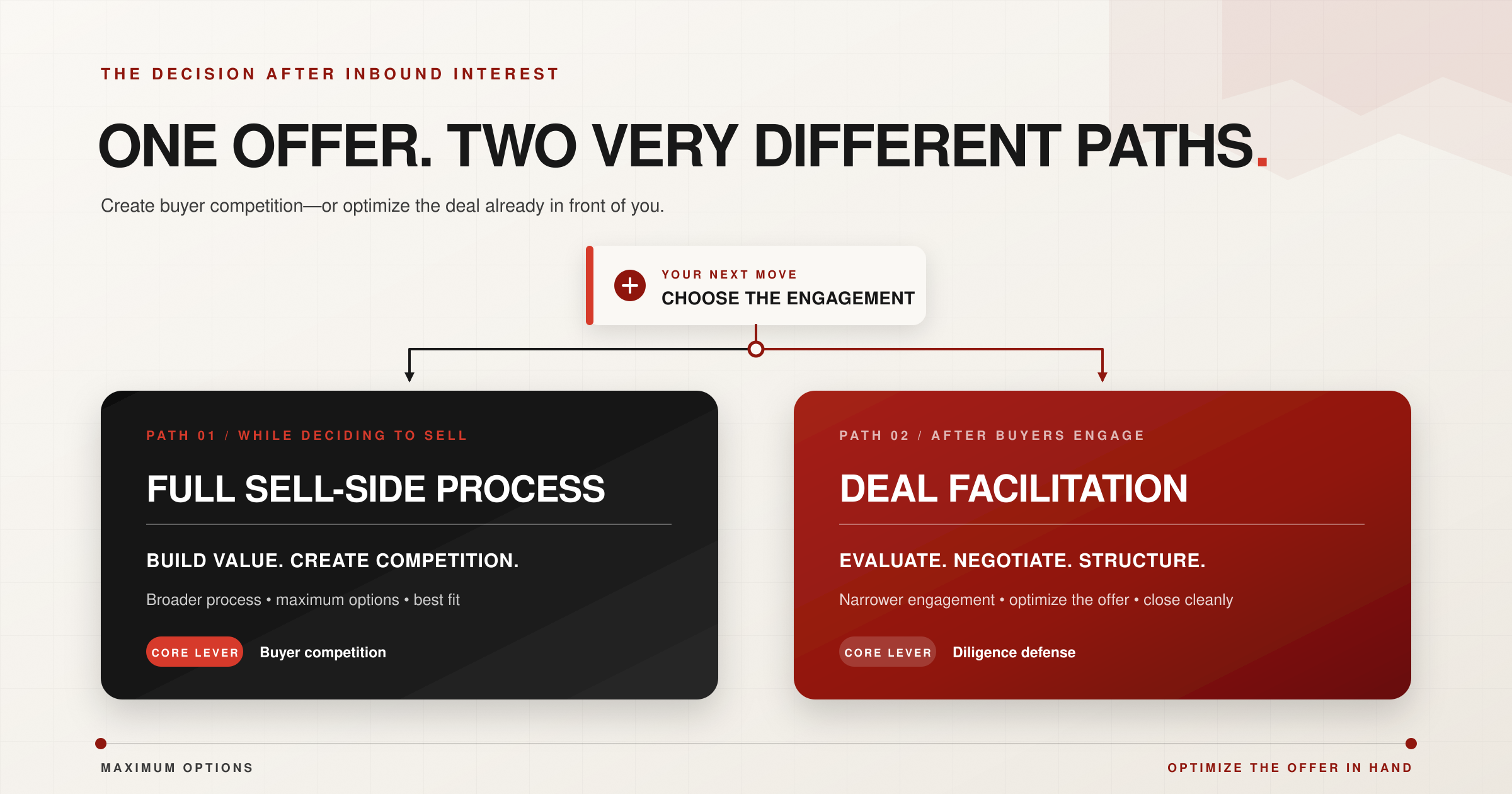
Deal facilitation vs. a full sell-side process: which fits?
There is more than one way in, because the right help depends on where your head already is. These are different engagements with different scopes and price tags.
| Consideration | Full sell-side process | Deal facilitation |
|---|---|---|
| When it starts | While you are still deciding to sell | After buyers have engaged, often post-LOI |
| What it does | Builds valuation and materials, runs outreach, brings a competitive short list | Helps you evaluate, negotiate, and structure the offer in front of you |
| Core lever | Buyer competition optimizes price, terms, and fit | Diligence defense and pre-diligence on your own numbers |
| Scope and cost | Broader, higher | Narrower, lower |
| Best for | Maximum options and best fit | An offer already on the table you want closed cleanly |
Facilitation meets you where you already are. In Mike’s framing: “You’ve already talked to buyers, you’ve already got some sense of value likely from competing offers, because the market’s speaking as to your value. Maybe you’ve signed an LOI, so you’ve already made a commitment to a particular buyer, and you’re like, okay, now what?”
We do not put our thumb on the scale. If you want the maximum number of options and the best fit, a full process is usually better, because buyer competition is the lever that moves price and facilitation does not have it. But we have had facilitation engagements where we determined the buyer was not right, and the client went back to another buyer, ran a full process, or used the time to improve the business instead. The point is to get help at the right moment for you.
These are exactly the trade-offs Mike, Ryan, and Matt work through on Shoot the Moon.
An offer just landed. What should you do first?
Do not engage emotionally, and do not start spending the proceeds in your head. Four things before you respond.
- Validate the buyer. Who are they, how qualified are they, what is their certainty to close, and what is their story? Have you already committed to a no-shop?
- Make sure the buyer wants what you want for your people. In our experience this is what sellers care most about and ask about least early on. Most founders we work with want to know their employees and their customers will be well taken care of after the transaction. A buyer’s answer to that question tells you a great deal about the rest of the deal, and it is much harder to get a straight answer once you are locked into exclusivity.
- Decide whether you are selling in or selling out, meaning whether you want to be around for a while afterward, and for how long.
- Talk to an M&A advisor before you respond, whether that is us or one of our peers. That is a phone call, not a commitment. It helps you pressure-test the offer, understand the buyer, and protect your optionality. If you are weighing that question more broadly, we cover it in full in do you need an M&A advisor to sell your IT services company, including the short answer on control: an advisor runs the buyer-side negotiation and coordinates your team, but as Mike puts it, “advisors don’t take control. We add leverage.” You make every final decision.
Revenue Rocket is a sell-side and buy-side M&A advisory firm focused exclusively on IT services companies (MSPs, cybersecurity, cloud, custom application development, and VARs) with 25+ years in the sector. We have sat on both sides of the table enough times to know where first offers tend to bend, and where a founder negotiating alone tends to give ground without realizing it.
If an offer just landed, the most valuable thing you can do is understand what it is really worth before you respond, while you still have the leverage to shape it. The earlier you have that conversation, the more options stay open to you.
Schedule a confidential conversation →
If you have an offer in hand, or several, we would welcome the call.
Hear the full conversation on Shoot the Moon, Episode 251: “Deal Facilitation and Handling Inbound Buyer Interest.”
Frequently asked questions
Is a signed LOI binding in IT services M&A?
Mostly no. The provisions that typically bind are the no-shop clause (your agreement not to talk to other buyers during a defined period of exclusivity), along with confidentiality and expense clauses. The purchase price, the deal structure, and the closing conditions can all still change in diligence. Until the buyer completes diligence and drafts the definitive agreement, the number is not binding.
What is a no-shop clause?
An exclusivity provision in a letter of intent under which the seller agrees to stop talking to other potential buyers for a defined period. It is one of the few parts of an LOI that is legally enforceable, and signing one removes competitive tension from the process, which is why it matters what you have established about your value before you agree to it.
Why are first offers usually not the best offers?
Most first offers are not optimized because there is no competition behind them. A single buyer has no incentive to bid against itself, the buyer’s corporate development team negotiates deals for a living while you do not, and a flattering number creates an anchor that can cap the final outcome. Sometimes the first offer genuinely is the best one, but you cannot know that without market context.
When is the best time to bring in an M&A advisor?
Earlier than most founders think. Ideally before an LOI is signed, once inbound interest has narrowed to a short list. That is when a third party can still affect the price rather than only defend it. Engaging post-LOI still adds real value through diligence defense and structuring, but the pricing leverage is largely gone.
What is the difference between deal facilitation and a full sell-side process?
A full sell-side process starts before you commit to sell and runs competitive outreach to optimize price, terms, and fit. Deal facilitation starts after a buyer has engaged, often post-LOI, and focuses on evaluating, negotiating, and structuring that specific offer to a clean close. Facilitation is narrower in scope and lower in cost, and it does not have buyer competition as a lever.
How many things get negotiated between LOI and close?
Roughly 150, by Mike Harvath’s count, spanning structure, working capital, reps and warranties, escrow and holdback mechanics, and closing conditions. Managing all of them while running the business is the single biggest source of deal disruption, and buyers use performance dips to retrade.
How long does a sell-side process take?
A full sell-side process typically runs six to twelve months from engagement to close. Building advisor relationships 12 to 24 months ahead of going to market gives founders the strongest position.